


In the digital world, businesses are turning to custom web applications to work smarter and grow faster. Think of it as having software built just for you that’s designed to solve your unique challenges and give you an edge over competitors. It’s not just helpful; it’s a game-changer.
Well, custom web applications give you the tools you need to work better, save time, and create amazing experiences for your customers. Unlike standard software, they’re made to fit your business perfectly.
If you want to improve your business, improve efficiency, or stand out from competitors, this guide is for you. You’ll learn how custom web application development can help your business grow, save time, and create better experiences for your customers.
According to Statista report, the global software application development market volume is estimated to reach about $250.00bn by 2029.
What is Custom Web Application Development?
Custom web application development is mainly the process of designing software specifically built to meet your business’s unique needs. While off-the-shelf solutions are designed for general use, custom web applications are crafted specifically for your unique goals and workflows.
These applications are built from scratch to solve particular problems, improve efficiency, and offer a flawless user experience. Whether managing customers, processing data, or handling inventory, a custom web app is designed to work exactly how your business needs it to.
In short, custom web application development or software development helps you create software that perfectly matches your business needs and offers flexibility, scalability, and control.
7 Most Popular Types of Custom Web Applications
Custom apps come in many forms depending on your business needs. These applications are designed to improve efficiency, enhance customer experience, or streamline internal processes.
Here are some of the most common types of custom web applications:
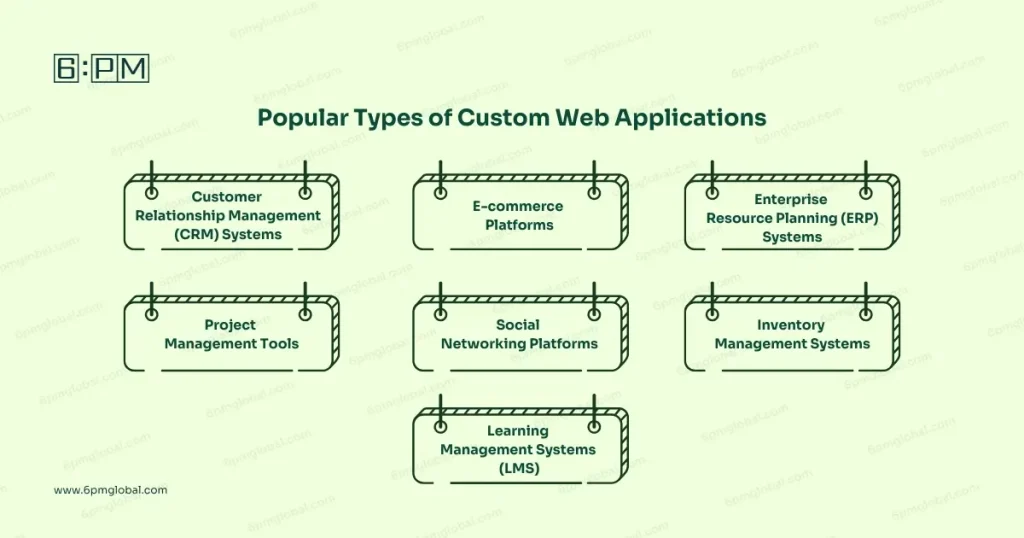
Customer Relationship Management (CRM) Systems
CRM systems help businesses manage customer interactions, sales, and support. They store customer data, track communications, and help build long-term relationships. With a custom CRM, you can build a web application tailored to your specific business workflows.
E-commerce Platforms
E-commerce web applications help businesses sell services online and manage transactions seamlessly. These platforms can include features like product catalogs, shopping carts, payment gateways, and order tracking. A custom e-commerce platform ensures a smooth user experience for your brand.
Enterprise Resource Planning (ERP) Systems
ERP systems merge various business processes into a single platform, such as accounting, human resources, and supply chain management. A custom ERP system can be designed to suit your company’s unique operations and make data management more efficient.
Project Management Tools
Project management tools help teams plan, track, and collaborate efficiently. They can include features like task assignment, timelines, progress tracking, and file sharing. These tools are ideal for businesses that need a solution tailored to their specific project workflows.
Social Networking Platforms
You’ll be glad to know custom social networking apps allow users to connect, share content, and engage with each other. These platforms can be built for communities or businesses looking to foster interaction between their users, employees, or customers.
Inventory Management Systems
These applications are used to track products, manage stock levels, and ensure that inventory processes run smoothly. A custom inventory system can be created to match your specific supply chain and warehousing needs.
Learning Management Systems (LMS)
LMS platforms are used for online learning and training programs. With a custom LMS, you can design courses, track progress, and manage assessments tailored to your organization’s training requirements.
Difference Between Custom Web App Development and Off-the-Shelf Solutions
Custom software solutions and off-the-shelf solutions offer different benefits. Below is a comparison of the two to help you understand which might be a better fit for your business:
| Aspect | Custom Web Application | Off-the-Shelf Solutions |
|---|---|---|
| On-demand Features | Designed specifically to meet your business needs and goals. | General features designed to meet common needs across industries. |
| Scalability | Web applications designed to scale can grow with your business, adding new features as needed. | Limited scalability; often requires upgrading to new versions or products. |
| Cost | Higher upfront cost, but long-term savings through customization and efficiency. | Lower initial cost, but may require additional licenses or upgrades over time. |
| Implementation Time | Takes longer to develop and launch due to customization. | Ready to use immediately after purchase and installation. |
| Flexibility | Highly flexible and adaptable to changing business needs. | Limited flexibility and customization options are often restricted. |
| Control | Full control over the design, functionality, and updates. | Limited control; dependent on the vendor for updates and bug fixes. |
| Support and Maintenance | Requires ongoing support from your development team or provider. | Support is usually provided by the vendor, but can be limited in scope. |
Benefits of Custom Web Application Development
Custom web application development offers several key benefits for businesses looking to improve their processes. Here’s why opting for custom development can be the right choice:

Customized to Your Business Needs
Web applications are designed specifically to fit your business. Instead of using a one-size-fits-all solution, you get software that addresses your exact requirements, making your operations more streamlined and efficient.
Scalability
As your business grows, a custom web app can grow with it. Custom apps are designed to adjust to changing needs, additional features, and increased users without significant change. This development process ensures that your software remains useful and flexible over time.
6PM Global provides scalable solutions through its flexible, on-demand web app development services. Their network of developers and CTOs ensures that your technology infrastructure can expand as your business needs evolve. By choosing a custom software development company like 6PM Global, you can avoid the long-term costs of rigid solutions and can scale efficiently.
Enhanced Security
Security is a major concern for any business, and custom web applications allow you to implement security measures matched to your specific needs. You can ensure your web or mobile app is secure and protects sensitive information with full control over data and user access.
Improved Efficiency
Personalized web apps are designed to automate and optimize your unique process. When you use web applications to automate tasks and integrate other tools, your team can focus on higher-priority tasks. Improving productivity and efficiency.
Competitive Advantage
Having a custom-built application gives you an edge over competitors using up-to-date software. You can offer unique features and adapt quickly to market trends, helping you stay ahead in a competitive industry.
Long-Term Cost Savings
While custom development involves higher initial costs, it can save you money over time by avoiding ongoing license fees, unnecessary features, and frequent upgrades. Your custom app will evolve with your business, reducing the need for costly replacements.
Full Control and Ownership
With a custom web application, you have full control over every aspect of the software. You can decide when and how to update it, ensuring that the app evolves alongside your business, and you won’t be tied to third-party vendor restrictions.
How Much Does It Cost for Custom Web Development
Here are some rough estimates for the cost of custom web application development services. However, it’s important to note that the actual costs can vary based on many factors, such as location, complexity, and development team.
Here are some general figures:
Simple Custom Web Application
Cost: $10,000 – $50,000
Description: A basic web application with minimal features such as user authentication, simple dashboards, web portal and limited integrations. This option could be a simple e-commerce site or a basic internal tool.
Medium Complexity Custom Web Application
Cost: $50,000 – $150,000
Description: The Medium Complexity type of app would include more advanced features like third-party integrations (e.g., payment gateways, CRMs), multiple user roles, and more sophisticated user interfaces. Examples include project management tools or mid-sized e-commerce platforms.
Highly Complex Custom Web Application
Cost: $150,000 – $300,000+
Description: Complex applications that involve advanced features such as real-time data processing, advanced security features, complex databases, AI/ML integration, web browsers, or highly customized workflows. It could include large enterprise resource planning (ERP) systems, healthcare management systems, or social networking platforms.
Other Influencing Factors
- Location of Developers: Developers in North America or Western Europe tend to charge $100-$250 per hour, whereas developers in Eastern Europe or Asia charge between $25-$75 per hour.
- Technology Stack: Some technologies, like specific enterprise tools, can add to the cost due to licensing or specialized skills.
- Maintenance Costs: After the initial development, expect to pay around 15-20% of the original development cost annually for maintenance, updates, and support.
Drawbacks of Custom Web Application Development
While web app development offers many benefits, there are some potential drawbacks to consider:
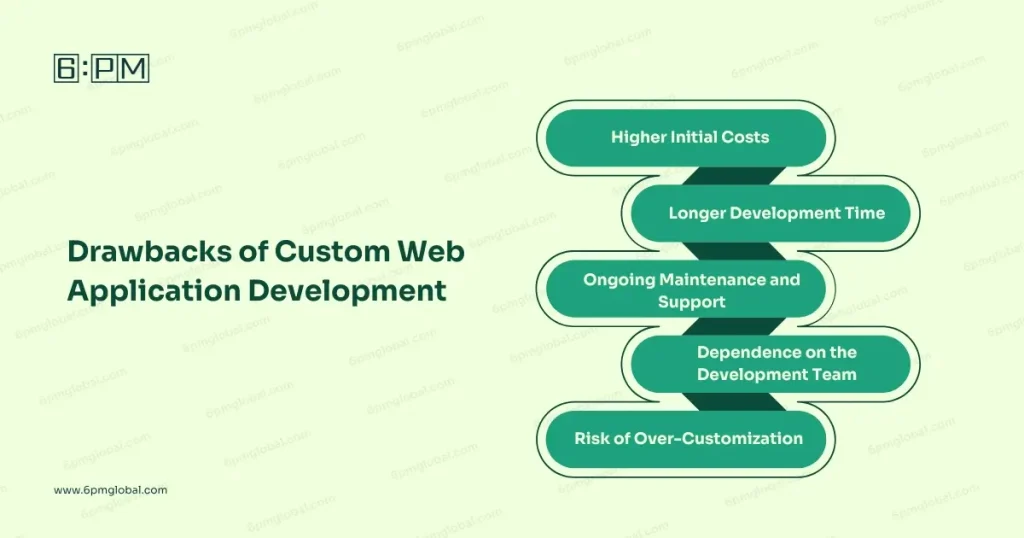
Higher Initial Costs
Custom software applications are more expensive to build upfront compared to off-the-shelf solutions. The cost of designing, developing, and deploying a tailored solution can be a significant investment, especially for small businesses or startups.
Longer Development Time
Creating a custom web application takes time. Depending on the complexity, the development process can take several months or even longer. If your business needs a quick solution, the longer timeline may be a drawback.
Ongoing Maintenance and Support
Custom apps require continuous maintenance to ensure they run smoothly and stay secure. You will need to invest in regular updates, bug fixes, and security patches, which adds to long-term costs.
Dependence on the Development Team
Since custom applications are built from scratch, you may become dependent on your original development team for future updates and fixes. Well, most of the report challenges when switching development teams due to compatibility issues or delays.
So, if they are unavailable or you switch teams, it may delay critical improvements or cause compatibility issues.
Risk of Over-Customization
Over-customizing your application can make it more complex than necessary. It can lead to higher costs, longer timelines, and potentially harder-to-maintain code. It is important to strike a balance between necessary customization and simplicity.
Selecting the Right Custom Web Application Developer
Choosing the right developer is a very basic step for the success of your custom web application development project. Here are some key factors to consider:
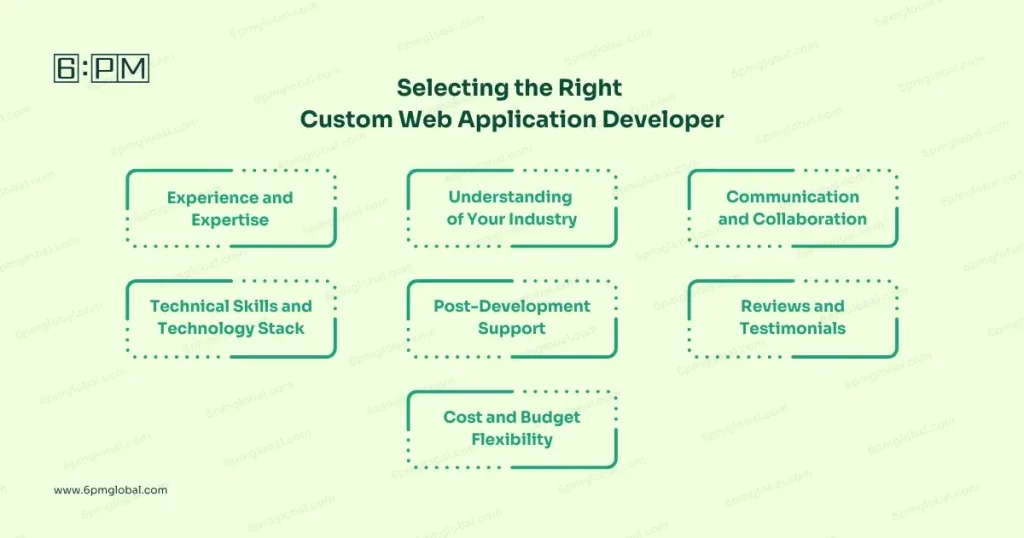
Experience and Expertise
Look for a development team with proven experience building custom web applications. They should be experts in the specific technologies and frameworks that match your project’s needs. Checking their portfolio and past projects can give you insight into their capabilities.
Understanding of Your Industry
It is essential to select a developer who understands your business and industry. A team familiar with your industry’s challenges and standards can offer better insights and create solutions that align with your goals.
Communication and Collaboration
Strong communication is key to a successful project. Ensure the developer is responsive and open to collaboration. They should provide regular updates, listen to your feedback, and be willing to make adjustments as the project progresses.
Technical Skills and Technology Stack
The developer’s technical skills and ability to work with the right technology stack are critical. They should be proficient in the languages, frameworks, and tools needed for your custom application, ensuring scalability, security, and long-term viability.
Post-Development Support
Building a custom web application is just the first step. Make sure the developer offers ongoing support and maintenance services. As your business evolves, you’ll need help with updates, bug fixes, and new features, so having a reliable post-launch support plan is essential.
Reviews and Testimonials
Check reviews and testimonials from previous clients to gauge the developer’s reliability and work quality. Positive feedback from other businesses can give you confidence that the developer will deliver on time and meet your expectations.
Cost and Budget Flexibility
While price shouldn’t be the only factor, finding a developer who can work within your budget is important. Ensure that the project can be grown as needed without having unforeseen costs and that the cost strategy is public from the start.
Real-World Example of Custom Web Application Development
Many well-known companies have seen tremendous success after building custom web applications to solve internal problems. For instance,
- Amazon Web Services (AWS): AWS started as Amazon’s internal cloud infrastructure, designed to support its growing e-commerce operations. It eventually evolved into a global leader in cloud computing, now serving millions of companies worldwide with scalable and flexible cloud solutions.
- Gmail: Gmail was initially developed by Google for internal use to improve email storage and performance. Its success within the company led to its public launch, making it one of the most widely used email services in the world today.
- Slack: Slack began as an internal messaging tool created by Tiny Speck during the development of their game Glitch. Although the game didn’t succeed, Slack proved so useful for communication that it was launched as a public product in 2013. It’s now one of the most popular team communication platforms globally.
These examples show why developing custom web apps can be a game changer. When you build custom web apps, they are modified to solve your specific challenges. As these companies have shown, your custom application could evolve into something far more valuable, potentially even becoming a product that benefits the broader market.
Conclusion
To wrap it up, custom web application development is a smart way to create solutions that fit your business perfectly. While it may take more time and cost a bit more at first, the long-term benefits like flexibility, scalability, and improved efficiency are often worth it.
You are looking at companies that turned their internal tools into game-changing products. Investing in a custom web app could give your business that competitive exposure. If you want a solution that truly works for your unique needs, you can contact us.
Ultimately, custom development is one of the best choices to scale your business.
FAQs
How long does it take to develop a custom web application?
The custom web application development timeline can range from several months to over a year, depending on complexity, features, and team size. Simple apps may take 3-6 months, while more complex systems could take longer.
What Types of Custom Web Applications Can You Develop for Your Business?
You can create tools like customer portals, e-commerce platforms, project management systems, or inventory tracking apps. These applications are built to match your specific needs and help improve your workflows and customer experiences.
How to choose a reliable custom web-based application development partner?
Look for a partner with experience, good reviews, and a portfolio of successful projects. They should understand your goals, offer clear communication, and provide ongoing support for a seamless development process and long-term reliability.
Are Portal Web Applications and Custom Web Applications the same?
No, they’re different. Portal web applications are a type of custom app focused on giving users access to specific features or information. Custom web applications, however, can serve a broader range of unique business needs.
Do I need a technical background to manage a custom web application?
Not necessarily. Most custom web applications are designed with user-friendly interfaces. While technical knowledge can be helpful, the app will be tailored to your needs, making it easier for non-technical users to manage daily operations.
Where to Find Custom Web Application Developers?
You can find web developers through platforms like LinkedIn, Upwork, or Clutch. Check their reviews, past work, and skills to ensure they can handle your project. Referrals from trusted sources are also a great option.
Is Custom Web App Safe?
Custom web applications can be very safe if built with security in mind. Developers use measures like data encryption, secure authentication, and regular updates to protect your business and user information from potential threats.