


Imagine your business data as a hidden treasure. Off-the-shelf databases are like generic maps – they might lead you somewhere, but not to your specific gold. Custom database software development is a map drawn just for you, which leads to insights and efficiency you never thought possible.
But be warned: building your custom map can be tricky. You might face unexpected costs, development delays, and security concerns. So, the solution is to plan carefully, choose the right experts, and prioritize security from the start.
In this guide, we’ll explore the power of customized database development: what it is, when you need it, the amazing benefits it has, and how to overcome the potential challenges.
Let’s start, shall we?
What is Custom Database Software?
Customized database development means building a database that fits your business perfectly. Instead of using generic software, you get a system designed to collect, store, and use your data in the best way possible. This addresses unique challenges, integrates easily with existing systems, and adapts to changing needs.
Moreover, these databases allow businesses to design their database application according to their specific needs. According to KridaTech, custom database software enhances efficiency by automating data entry, retrieval, and reporting tasks. The knowledge is used to create rules that ensure data quality.
Therefore, by choosing custom development, you invest in strategic tools that drive innovation and give you a successful lead.
When Do You Need Custom Database Software?
More and more businesses are opting for personalized database development. But how do you know when it’s the right choice for you? Here are some scenarios where a custom solution becomes essential:
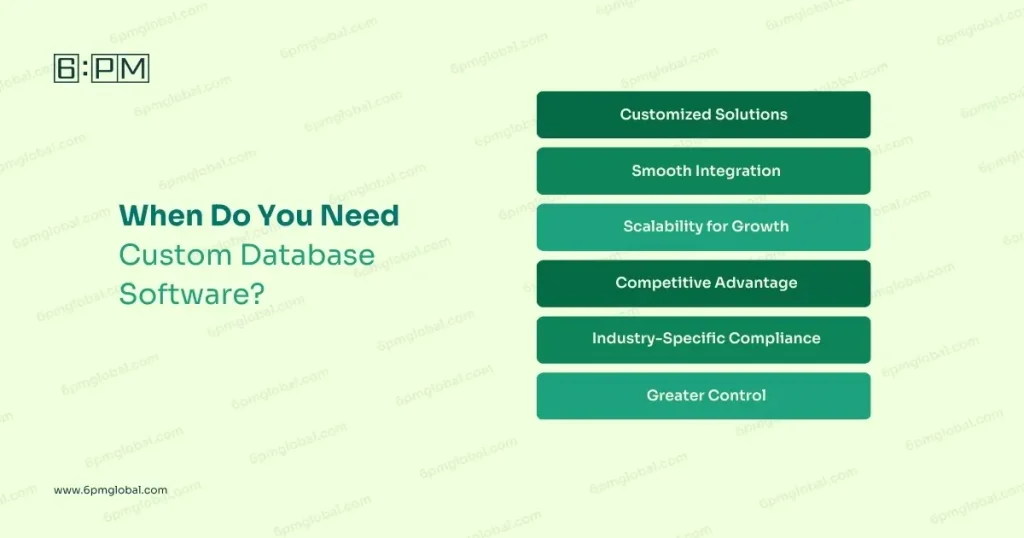
Customized Solutions
Generic software can be limiting. Custom solutions offer the control and flexibility to handle specific workflows and data requirements. Think of it as a personalized suit versus one off the rack. It fits perfectly, addressing your individual business processes.
Smooth Integration
Custom databases can help when your business needs to connect different systems. They ensure seamless integration with your current applications, creating a unified and efficient workflow.
Without it, you may waste time entering the same data in multiple applications. This improves data flow and reduces errors.
Scalability for Growth
As your company expands, a custom database can grow with you. It adapts to increasing data and user demands, ensuring performance isn’t compromised. This scalability is crucial for long-term success, offering a system that evolves alongside your business. Generic systems may not handle this growth as effectively.
Related Article: Custom Development vs Packaged Software: A Comparison Guide
Competitive Advantage
Customized databases can provide insights that give you an advantage over competitors. They offer unique features and analytical capabilities tailored to your specific market. This means you can better understand your data, spot opportunities, and make better decisions.
Note that, such insights can be hard to get using off-the-shelf options.
Industry-Specific Compliance
Certain industries have specific data and regulatory needs. Custom databases can be built to meet these unique requirements, ensuring compliance and security.
Whether it’s healthcare, finance, or any other specialized field, a personalized solution ensures you meet industry standards. For example, this can involve following normalization rules.
Greater Control
If you want greater control over your data, custom software is the answer. You gain more flexibility and functionality compared to generic options. This allows you to fine-tune every aspect of your database, ensuring it aligns perfectly with your business objectives.
Also, this provides a more effective database management system, which is really praiseworthy.
What are the Benefits of Custom Database Software Development?
Investing in custom database management offers a multitude of benefits that can impact your business’s success:

Perfectly Tailored Solutions
Custom software fits your business needs exactly. Unlike generic options, custom database solutions handle your specific data and processes. This ensures your database works efficiently, meeting your business’s unique requirements.
Increased Efficiency and Output
These databases automate tasks, saving time and reducing mistakes. Employees access data faster, improving productivity. This efficiency lets your team focus on important tasks and quickly address business needs.
Strong Data Security
Security is key, and customized data offers strong protection for your data. You can add features like encryption and user authentication to safeguard your data. This protects against cyber threats targeting standard software.
As per MRFR analysis, The Custom Software Development Market Industry is expected to grow from 78.74(USD Billion) in 2024 to 120 (USD Billion) by 2035 and the annual growth rate (CAGR) is expected to be around 3.91% during the forecast period (2025 – 2035).
Scalable Architecture
As your business expands, custom databases easily handle more data and users. This ensures the smooth integration of new processes and features. Your database grows with you without needing a complete replacement.
Sustainable Cost Efficiency
Custom software can save money long-term, despite a higher initial cost. You cut operational expenses by reducing manual data entry and eliminating multiple software licenses. Plus, improved efficiency ensures a solid return on investment.
What are the Challenges of Custom Database Software Development?
While the benefits are numerous, it’s important to acknowledge the potential challenges associated with personalized database software:

Longer Development Time
Custom solutions take longer to build than off-the-shelf software. Depending on how complex your database needs to be, development can range from weeks to months. Understanding this upfront helps in planning project timelines for sure.
Higher Initial Cost
Expect to pay more for a custom database upfront than buying an existing solution. This is because you’re paying for a solution customized to your needs. While it may be more expensive initially, the long-term benefits can outweigh the costs.
Ongoing Maintenance
These databases require continuous maintenance, updates, and support. These are essential to ensure your database runs smoothly and securely. Thus, make sure to factor these costs into your budget.
Security Concerns
Bespoke software demands strict security to keep your data safe. Security measures such as access controls, encryption, and auditing are needed to protect data against breaches. If these measures are not in place, your application can be vulnerable to attacks.
Unclear Requirements
Unclear requirements and changing goals can cause projects to exceed budget and schedule.
To avoid this, it’s essential to have regular meetings with stakeholders and emphasize user cases through prototyping. With thorough planning, you can build a great foundation for your business.
The Bottom Line
In summary, custom database software development provides adaptable solutions that expand as your company evolves. It delivers key insights, increases efficiency, and improves data security, giving you a competitive edge.
Therefore, building this database means creating a simplified system that aligns with your objectives and grows alongside your operations. You can build a great asset to grow your business forward with thorough preparation and an expert team.
Ready to see what a custom solution can do for your data? Contact 6PM Global today and let’s build your data’s future, together.
FAQs
How long does personalized database development take?
Development time varies depending on complexity, ranging from a few weeks to several months. Factors include the number of features, integrations required, and the development team’s experience. Discuss timelines thoroughly with your vendor.
How much does customized database development cost?
Costs vary based on complexity, features, and the development team’s rates. A detailed assessment of your needs will determine the final price. Consider it an investment with long-term returns through efficiency and tailored fit.
What technologies are used in custom database development?
Common technologies include SQL, MySQL, PostgreSQL, and NoSQL databases. Programming languages like Python, Java, and PHP may be used for application development. The choice depends on your specific requirements and budget.
How do I start a customized database project?
Start by defining your requirements, outlining your goals, and identifying your budget. Research potential development teams and ask for proposals. Discuss your needs, review their expertise, and choose a team that aligns with your vision.
How do I ensure data security in a custom database?
Implement security measures like encryption, access controls, regular backups, and security audits. Work with a development team that prioritizes security and follows industry best practices to protect your sensitive data.