


Are you struggling to make your online store stand out in a crowded market? To stay ahead, businesses need more than just an online store and custom e-commerce software development is the best solution for that. Seamless user experience, security, and personalization are now key drivers of customer satisfaction in e-commerce.
A report by SkyQuest says that, Global E-commerce Software Market size was valued at USD 6.1 billion in 2023 and is poised to grow from USD 7.03 billion in 2024 to USD 21.97 billion by 2032, growing at a CAGR of 15.3% during the forecast period (2025-2032).
Pre-built e-commerce platforms do provide a quick start, but they come with limitations. Generic templates, restricted customization, and integration issues often lead to scalability problems.
Custom-built e-commerce offers better security, enhanced user experience, and the ability to scale effortlessly. Instead of adapting to a rigid platform, you can build one that fits your exact needs.
In this blog, we’ll explore everything about custom e-commerce software development, its benefits, challenges, costs, development timelines, and real-world examples.
What Is Custom E-commerce Software Development?
Have you ever felt limited by platforms like Shopify, WooCommerce, or Magento? Then you’re not alone. Pre-built e-commerce solutions are great for getting started quickly, but they come with restrictions like limited customization, scalability issues, and often, hidden costs.
That’s where custom e-commerce software development comes in. Custom e-commerce software is a custom-made online store designed specifically for your business needs.
Who Benefits the Most?
Not every business needs a custom e-commerce platform. But if you’re running a large-scale store, subscription service, B2B marketplace, or a niche brand with unique requirements, a pre-built solution might hold you back. Custom e-commerce is ideal for:
- Enterprises & growing brands that need advanced features and flexibility.
- B2B companies with complex pricing models and bulk ordering needs.
- Luxury or niche brands that require exclusive, high-end user experiences.
- Multi-vendor marketplaces looking for custom commission structures and vendor management.
Related Article: Custom Software Solutions: Increase Productivity Upto 50%
Benefits & Features of Custom E-commerce Software Development?
If you want an e-commerce platform that truly represents your brand, offers a seamless shopping experience, and grows with your business, a custom-built solution is the way to go.
Unlike pre-made platforms, custom e-commerce software development gives you full control over features, security, and scalability. Let’s break down the biggest benefits.
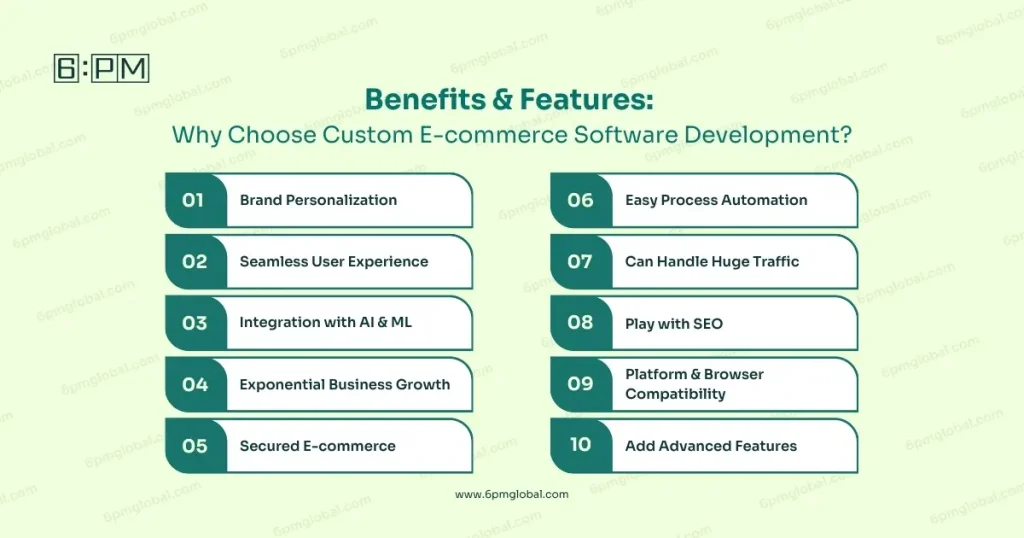
Brand Personalization
Your e-commerce store will also serve as a brand experience. With custom development, you can:
- Create a unique look and feel that aligns with your brand identity.
- Customize everything from product pages to checkout flows, without being stuck with any limitations.
- Stand out from competitors instead of using the same generic designs found on any pre-made platforms.
Seamless User Experience
A smooth and intuitive shopping journey keeps customers engaged and boosts conversions. Custom development allows you to:
- Optimize UI/UX based on your audience’s behavior.
- Ensure mobile responsiveness so your store looks great on all devices.
- Streamline navigation with a checkout process that reduces cart abandonment.
Integration with AI & ML
AI-powered e-commerce is the future. Custom solutions let you:
- Personalize shopping experiences with AI-driven recommendations.
- Automate customer support using chatbots that handle queries 24/7.
- Use predictive analytics for dynamic pricing, fraud detection, and customer behavior insights.
Exponential Business Growth
Pre-built platforms often limit how much you can scale. A custom e-commerce solution:
- Grows with your business without hitting technical restrictions.
- Supports unlimited products, users, and traffic without performance drops.
- Lets you add new features whenever you need them, without waiting for platform updates.
Secured E-commerce
Security is a major concern for online businesses. Custom development helps you:
- Implement advanced encryption to protect user data.
- Integrate secure payment gateways with multi-layer fraud detection.
- Avoid third-party vulnerabilities that come with pre-built platforms.
Easy Process Automation
Manually managing inventory, orders, and customer service is time-consuming. With custom software, you can:
- Automate inventory tracking to prevent stockouts.
- Use AI-driven chatbots to handle customer inquiries instantly.
- Streamline marketing campaigns with automated email sequences and push notifications.
Can Handle Huge Traffic
During peak seasons, your site needs to handle high traffic without slowing down. Custom-built platforms:
- Are optimized for performance, preventing crashes during big sales.
- Use scalable cloud hosting to handle sudden traffic spikes.
- Outperform off-the-shelf platforms, which often struggle under heavy loads.
Play with SEO
With custom development, you get full control over SEO, helping you rank higher on search engines. This means:
- Custom URL structures for better search visibility.
- Schema markup and rich snippets to enhance product listings in Google.
- Advanced analytics tracking to optimize SEO strategies.
Platform & Browser Compatibility
Pre-built platforms may not always work well across different devices. Custom e-commerce solutions:
- Ensure seamless functionality on desktops, tablets, and mobile phones.
- Work smoothly across browsers like Chrome, Safari, and Edge.
- Offer a consistent experience, no matter how customers access your store.
Add Advanced Features
Want to future-proof your e-commerce business? Custom software lets you:
- Integrate AR shopping for a next-level user experience.
- Enable voice search to make shopping easier.
- Use blockchain for payments, adding an extra layer of security and flexibility.
Related Article: Ecommerce Software Development: Benefits and Challenges
Challenges to Keep in Mind While Developing Custom E-commerce Software
While custom e-commerce software offers flexibility and growth potential, it has its own set of challenges. Here are key factors to consider before diving in:
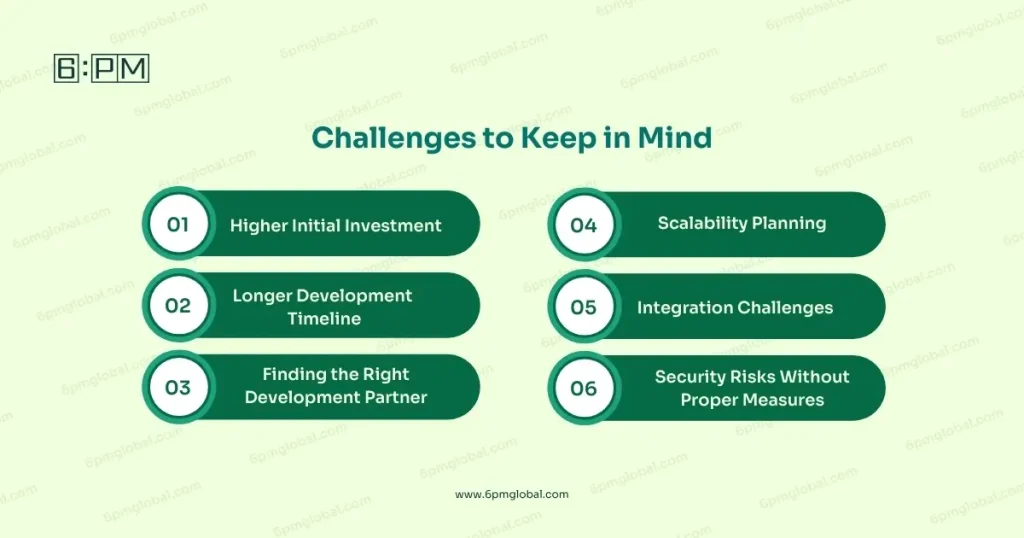
Higher Initial Investment
Firstly, when it comes to cost, custom development requires a bigger upfront budget. You’re investing in customized solutions rather than just buying software. But in the long run, your investment often pays off.
Longer Development Timeline
Unlike off-the-shelf platforms, custom solutions take time as every feature is built from scratch, tested, and refined. However, this extra time ensures the final product fits your business perfectly.
Finding the Right Development Partner
Choosing the right development team is important for your custom e-commerce platform. The wrong developers can lead to delays and poor results. So you should always check their experience and past projects before making a decision.
Scalability Planning
As your business grows, your platform needs to grow. If you do not plan properly it might struggle with increased traffic. So, it’s important to build with scalability in mind from the start.
Integration Challenges
If you rely on third-party tools, integration can be a challenge. Without proper planning, systems may not work well together. But with the right approach, you can avoid most of these problems.
Security Risks Without Proper Measures
Finally, there’s security. While custom platforms can be highly secure, it depends on how they’re built. Without strong security practices, vulnerabilities can slip through. Prioritize this from day one to stay protected.
Custom E-commerce Software Development: Cost & Timeline
Here’s an estimated breakdown of custom e-commerce software development costs and timelines, based on various factors and sources:
| Complexity Level | Estimated Cost | Estimated Timeline | Features |
|---|---|---|---|
| Basic | $10,000 – $50,000 | 2 – 2.5 months | Essential e-commerce features: product listings, shopping cart, payment gateway, basic UI/UX. |
| Mid-Range | $50,000 – $100,000 | 4 – 6 months | Custom design, advanced analytics, third-party integrations, enhanced security, and mobile responsiveness. |
| Advanced | $100,000 – $500,000 or more | 10 months or more | Multi-vendor support, complex workflows, extensive scalability, advanced security, automation etc. |
The cost and the development duration highly depend on the number of features, integrations, testing phases and development team location. So, these numbers can vary depending on your platform’s demand.
Case Study: How Nike Boosted Sales with Custom E-commerce Development
Initial Challenges:
While Nike was using third-party e-commerce platforms, they faced significant limitations and struggled with:
- Limited control over customer data and personalization.
- Difficulty scaling during high-traffic events like product launches.
- Inconsistent user experiences across global markets.
The Custom Development Solution:
Nike decided to invest in a custom e-commerce platform. Their strategy included:
- Personalization: Using AI-driven algorithms to offer specialized product recommendations.
- Seamless Integration: Merging the platform with their mobile app, loyalty program, and inventory systems.
- Global Scalability: Designing for multiple regions with localized content, languages, and currencies.
The Results:
- Direct-to-Consumer (DTC) Sales Growth: Nike’s DTC sales grew to $16.4 billion in 2021, a 35% increase from the previous year.
- Mobile Sales Surge: The Nike e-commerce app saw a 150% growth in active users after the custom integration.
- Enhanced Customer Engagement: Personalized experiences boosted customer retention rates significantly.
Conclusion
Lastly, is custom e-commerce software development worth it? If you want a platform that’s built around your business, not the other way around then it definitely checks out. It might cost more upfront and take longer to develop, but you cannot ignore the long-term benefits.
At the end of the day, it’s all about your business needs like brand identity, better security, room to grow, and the freedom to add features that truly matter to your customers. Now that you know the pros, cons, and real-life success stories, it’s time to think about your next move.
You can try consulting with an expert from a trustable platform like 6PM Global, research more case studies, or even be at the start of the development process. Whatever it is—make sure it’s the right fit for your business goals.
FAQs
What is custom e-commerce development?
Custom e-commerce development means creating an online store that’s customized for your business—how it looks, works, and even the features it has. You’ll get full control to design it the way you want rather than.
How long does it typically take to build a custom e-commerce website?
The development timeline depends on how complex your software is. If it’s a simple store, it might take a couple of months. But if you want advanced features—like custom payment systems or AI recommendations—it could take four to six months, sometimes more.
What are the benefits of custom e-commerce development?
Custom development allows for personalized branding, enhanced user experiences. Whatever you need, whether it’s a unique design, special features, or tools that work with your business systems. Plus, it’s easier to scale as your business grows.
How much does it cost to develop a custom e-commerce website?
Cost to develop a custom e-commerce website is generally higher than using pre-built solutions due to the customized approach. But it really varies, If you just need the basics, it might cost around $10,000–$50,000. But if you want something complex with advanced features, it can go over $100,000.
Is custom e-commerce development suitable for small businesses?
While custom e-commerce development offers numerous advantages, small businesses must consider their budget and resources. For some, a custom solution can provide the flexibility and scalability needed for growth, but it’s essential to weigh the costs and benefits carefully.