


Did you know that B2B e-commerce will exceed 3 billion dollars in sales by 2027? This highlights the growing importance of B2B e-commerce website development for businesses trying to simplify operations, expand reach, and improve customer experience.
Well, developing a B2B ecommerce website covers planning, choosing the right platform, and integrating essential features. It also involves catalog management, order processing, and secure payment gateways.
Read this blog to learn more about creating a successful B2B e-commerce website. Find out practical tips and strategies to expand your business’s online presence and drive growth.
Let’s start!
Definition of B2B E-commerce
B2B e-commerce also known as business-to-business electronic commerce, is the way of exchanging products, services, or information between businesses to businesses through online. You can use it to sell goods, provide services, and share information through digital platforms.
The website’s main purpose is to make your business transactions easier by offering an online space where companies can manage orders, and build partnerships. Also, this method helps your business operate more efficiently.
So, by using B2B e-commerce website development, you can simplify operations, reduce costs, and improve your business’s overall effectiveness.
Difference Between B2C vs B2B Ecommerce
B2B and B2C e-commerce serve different purposes and have distinct characteristics. Here’s a comparison to highlight the key differences:
| Aspect | B2B E-commerce | B2C E-commerce |
|---|---|---|
| Transactions | Between businesses | Between businesses and individual consumers |
| Order Size | Often involves bulk orders | Typically involves single or small quantity orders |
| Pricing | Customized pricing | Fixed pricing |
| Relationships | Long-term relationships | One-time or short-term transactions |
| Negotiations | Requires complex negotiations | Simple and quick purchasing process |
| Target Audience | Specific business needs | Broad consumer audience |
| Real-life Platform | A retailer uses Alibaba to buy products in bulk from a supplier | Amazon allows individual customers shopping for a single product for personal use. |
Importance of B2B eCommerce Website Development
Developing a B2B e-commerce website is necessary for several reasons:
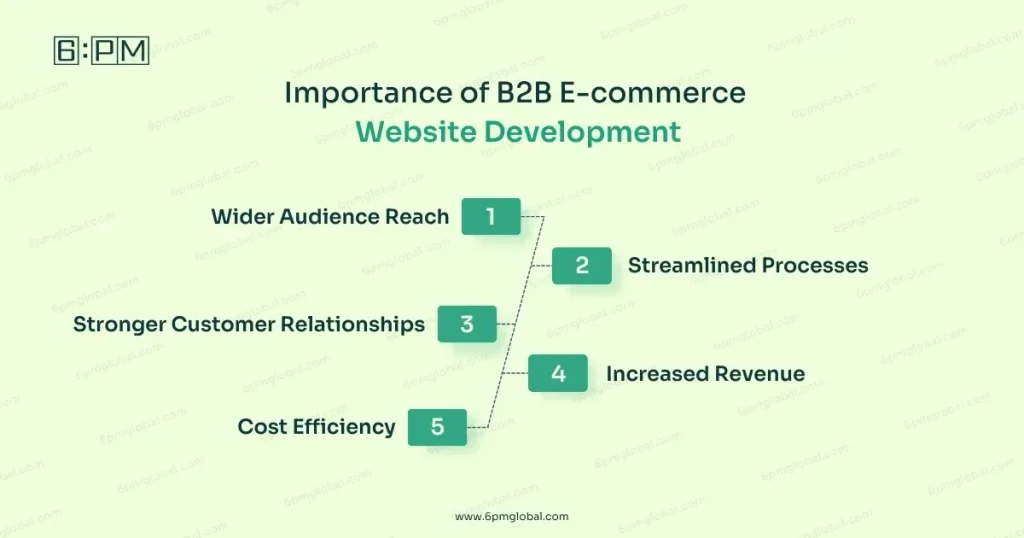
Wider Audience Reach
Online platforms allow you to reach a global market. This broad access helps you attract more customers from different regions, improving your business’s visibility and potential for growth.
Streamlined Processes
Automation of sales processes reduces errors and saves time. So, you can enhance efficiency and minimize manual tasks by automating order management, inventory tracking, and customer service.
Stronger Customer Relationships
Now, personalized experiences gain customer loyalty. Tailoring the user experience to meet individual customer needs helps build long-term relationships and repeat business.
Increased Revenue
Enhanced visibility and simplified operations drive sales growth. A well-optimized ecommerce site attracts more traffic and converts visitors into b2b buyers which increases your overall revenue.
Cost Efficiency
Last but not least, reducing operational costs through automation and digital processes helps a lot. By minimizing manual work and optimizing resource use, you can cut costs and improve your profit margins.
Types of B2B E-commerce Website Models
B2B e-commerce websites come in various types, depending on their business models, functionality, and target audience. Here are the main types of B2B business websites:
Supplier’s Own Website
A website model where a single company or manufacturer sells directly to other businesses. For example, Cisco sells networking equipment like routers directly to companies. It allows businesses to buy directly from the supplier without a middleman.
Big Buyer’s Website
A large company creates a website where other suppliers can offer products to them. A company like General Electric may have a site for suppliers to bid on contracts for providing raw materials.
It will make things easy for your company to manage suppliers.
Middleman Marketplace
Middleman marketplace is a type of platform where many businesses both B2B buyers and sellers can connect. Like how Alibaba connects suppliers with businesses that want to buy products in bulk all around the world worldwide.
The model helps businesses to find suppliers easily without having direct connections.
Industry-specific Websites or Vertical B2B
Industry-specific ecommerce websites that focus on a single industry. It is a site that only sells medical equipment to hospitals. This helps businesses in the same industry get specialized products and services.
Horizontal B2B
E-commerce Websites that sell products for many industries are known as horizontal b2b websites. For example, Amazon Business sells office supplies, tools, electronics, and more to all types of businesses. It offers businesses a one-stop shop for anything they need.
Hybrid B2B or B2C
Websites that serve both businesses and individual shoppers are hybrid. Amazon Business lets companies buy in bulk, but regular people can shop there too. Both businesses and regular consumers can use the same platform for different needs.
Steps of Building a B2B E-Commerce Website Development
Developing an e-commerce website involves several steps and best practices from planning to launching and maintaining the platform.
Here is a simplified, step-by-step guide:
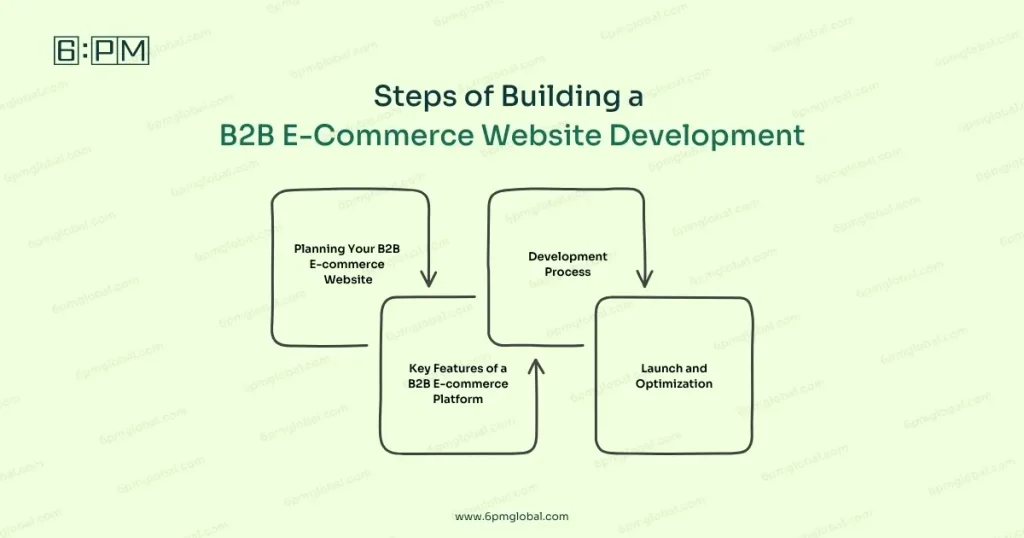
Step 1. Planning B2B E-commerce Website Development
Effective planning is important for successful B2B ecommerce web development. Let’s find out how you can do it:
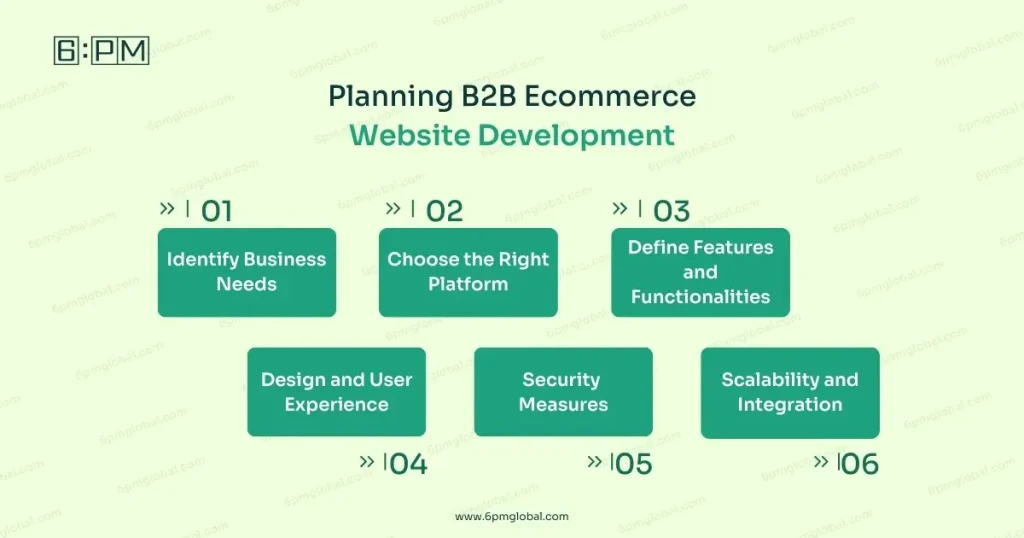
- Identify Business Needs: Understand your business goals and the needs of your target audience. Determine what products or services you’ll offer and outline the ecommerce features your platform needs.
- Choose the Right Platform: Select a platform that aligns with your goals. See if it is scalable, and supports integration with other tools.
- Define Features and Functionalities: Identify features like bulk ordering, custom pricing, order management, and secure payment options. Ensure these features can handle the complexities of your B2B transactions.
- Website Design and User Experience: Make a well-designed interface that enhances engagement and simplifies purchasing for customers.
- Scalability and Integration: Ensure the platform can grow with your business and connect smoothly with systems like ERP, CRM, and marketing tools.
Step 2. Key Features of a B2B E-commerce Platform
A successful B2B website requires features customized to business needs. Here are the essentials:
- Catalog Management: Use a system to organize and display products effectively, supporting bulk uploads and detailed descriptions. It ensures customers always have accurate, updated product information.
- Order Management: Include tools to handle orders from placement to fulfillment, such as shipment tracking and returns processing. Efficient order management enhances customer satisfaction and operational efficiency.
- Payment Gateway Integration: Support multiple payment options like credit cards, bank transfers, and digital wallets.
- Inventory Management: Proper inventory management prevents overstock or stockouts, ensuring smooth delivery to customers.
- Security Measures: Implement SSL certificates, data encryption, and compliance with industry standards like PCI-DSS to protect sensitive information and build customer confidence.
Step 3. Development Process
Once planning is complete and key features are defined, move into the development phase:
- Backend Development: Build the foundation for catalog management, order processing, inventory tracking, and customer account roles. Integrate tools for custom pricing and bulk order processing.
- Frontend Development: Design user-friendly interfaces with advanced search, product filtering, and responsive layouts for mobile, tablet, and desktop users. Ensure the platform looks professional and goes well with your brand identity.
- Integration: Connect the platform with third-party systems like ERP for inventory and orders, CRM for customer relationships, and marketing tools for operations without any problems.
- Testing: Perform usability, performance, and security tests to ensure the platform works smoothly under real-world conditions. Identify and fix any issues before launch.
Step 4. Launch and Optimization
After development, follow these steps to launch and improve your platform over time:
- Soft Launch: Start with a small group of users to gather feedback and address any remaining issues.
- Full Launch: Open the platform to all target customers, ensuring everything is ready for high-volume usage.
- Monitor and Improve: Collect feedback regularly, track performance metrics, and update features as customer needs evolve. Maintain strong security protocols to protect user data and ensure compliance.
How to Overcome Common Challenges in B2B Website Development
While building an ecommerce business website you will face your own set of challenges. Here are some common challenges and suggested ways to overcome them:
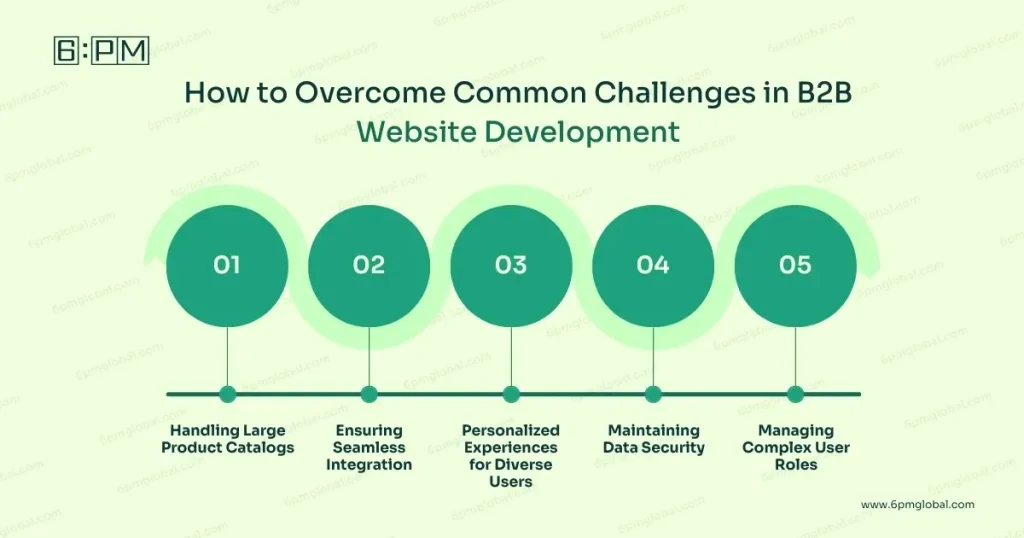
Handling Large Product Catalogs
Problem: A growing number of vendors and products in the ecommerce market can overwhelm your system, which leads to slow load times and poor user experience.
Solution: Use a scalable database with optimized indexing.
Ensuring Seamless Integration
Problem: Integrating third-party tools like ERPs, CRMs, and payment gateways can lead to data inconsistencies and hamper your website workflow.
Solution: Use APIs and middleware platforms to bridge systems. Prioritize integrations during development and regularly test data synchronization to avoid errors.
Personalized Experiences for Diverse Users
Problem: Catering to both B2B companies (bulk orders, efficiency) and B2C customers (fast checkout) can be conflicting.
Solution: Use AI-based algorithms for personalized recommendations. Develop distinct interfaces or dashboards for B2C and B2B sales.
Maintaining Data Security
Problem: Handling sensitive vendor and customer data increases the risk of breaches or non-compliance with regulations.
Solution: Implement advanced security measures like encryption, multi-factor authentication (MFA), and regular vulnerability assessments. Stay updated with compliance standards such as GDPR or PCI DSS.
Managing Complex User Roles
Problem: B2B and B2C platforms each require specific permissions and access levels. Mismanaged roles can lead to unauthorized access or restricted usability.
Solution: Implement a role-based access control (RBAC) system. Clearly define user roles during the design phase.
Case Study: Alibaba’s E-commerce Website Development
Alibaba Group is one of the world’s largest e-commerce platforms. Its development journey provides insights into how a B2B e-commerce website can scale into a global powerhouse. Let’s go through a case study on Alibaba.
Background
- Founded: 1999
- Founder: Jack Ma
- Primary Purpose: To connect Chinese manufacturers and suppliers with international buyers.
- Core Business Model: B2B (business-to-business), later expanded to B2C (business-to-consumer) and C2C (consumer-to-consumer).
Alibaba.com focuses on facilitating trade between businesses, offering a marketplace where buyers and sellers can connect and transact efficiently.
Development Journey
1. Identifying Market Needs
- Problem: In the late 1990s, small and medium-sized enterprises (SMEs) in China had limited ways to reach international buyers.
- Solution: Alibaba created a platform to connect these businesses with global markets. This addressed a critical gap and positioned Alibaba as a pioneer in B2B e-commerce.
2. Platform Design and Features
The platform was designed with simplicity and functionality in mind, catering to businesses with varying levels of digital literacy.
Key Features:
- Supplier Listings: Businesses could list products with detailed descriptions and images.
- Buyer Tools: Buyers could search for products, compare suppliers, and request quotes.
- Secure Payments: The introduction of Alipay, a third-party payment system, ensured secure transactions.
- Verification System: To build trust, Alibaba introduced a supplier verification system, helping buyers identify reliable sellers.
User Interface:
- Simple, intuitive design focused on ease of navigation.
- Multi-language support to cater to global users.
3. Technological Infrastructure
Alibaba invested heavily in building a strong technical foundation to support its platform:
- Scalability: The platform was built to handle millions of users and listings simultaneously.
- Cloud Computing: Imposing Alibaba Cloud, the platform ensured fast performance, high uptime, and scalable storage.
- AI and Data Analytics: Used to personalize user experiences, recommend products, and improve search functionality.
4. Monetization Strategies
They adopted innovative monetization strategies to grow its business:
- Membership Fees: Sellers could pay for premium memberships to get better visibility.
- Advertising: Businesses could purchase ad space to promote their products.
- Transaction Fees: Revenue from secure payments and transactions.
5. Expanding Globally
Alibaba used strategic partnerships and localization to enter new markets:
- Partnered with logistics companies to streamline international shipping.
- Localized its platform to cater to regional markets with language, currency, and cultural adaptations.
Challenges Faced
- Trust Issues: Convincing global buyers to trust Chinese suppliers was an initial challenge. Alibaba tackled this by building a supplier verification system.
- Competition: Faced strong competition from platforms like Amazon and eBay. Alibaba differentiated itself by focusing on wholesale and B2B markets.
- Scalability: Ensuring the platform could handle rapid growth required continuous investment in technology.
Results and Achievements
- Market Reach: Alibaba.com connects millions of buyers and suppliers across 190+ countries.
- Revenue Growth: The B2B platform has become a significant revenue driver, contributing to its dominance in the e-commerce space.
- Global Influence: Today, they serve as a model for B2B e-commerce platforms worldwide.
Takeaways from Alibaba’s Success
Alibaba succeeded by addressing the needs of Chinese SMEs and building trust with verified suppliers and secure payments. They used advanced technology for continuous growth and ensured profitability through a diverse revenue pipeline.
Strategic global expansion, localization and up-to-date technology secured their position as a B2B e-commerce leader.
Conclusion
To sum up, B2B ecommerce website development is a complex process that requires careful planning, the application of essential features, and effective marketing strategies.
By focusing on these areas, you can create a great online platform that enhances efficiency, broadens your reach, and drives revenue growth.
Remember that a well-developed B2B e-commerce website improves operational effectiveness and meets your business’s and customers’ evolving needs. So, embrace these strategies to stay competitive and succeed in the digital marketplace.
If you need any expert guidance regarding building your e-commerce website development you can consider 6PM Global. Transform your vision into reality today!
Good luck!
FAQs
How do I create a B2B ecommerce website?
1. The steps to build a B2B ecommerce website:
2. Identify business needs and target audience.
3. Choose a scalable e-commerce platform.
4. Define essential features and functionalities.
5. Design a user-friendly and responsive interface.
6. Develop backend systems for orders and inventory.
7. Integrate CRM, ERP, and other tools.
8. Implement strong security measures.
9. Test for usability and performance.
10. Launch and continuously optimize.
How much does it cost to build a B2B e-commerce website?
Costs vary depending on features, platform choice, web design and customization needs. Typically, expenses include platform fees, development, integrations, security measures, and ongoing maintenance.
How can I customize my B2B e-commerce website?
Customization can include proportional pricing, personalized user accounts, custom workflows, and branding. Many platforms support APIs and extensions for integrating additional features unique to your business needs.
For suggestions from expert CTOs, consider connecting with 6PM.
How can social media marketing help my B2B e-commerce business?
Social media and digital marketing build brand awareness and engage with your audience. Sharing content, interacting with followers, and participating in industry discussions fosters direct communication with potential customers.
What is order management in B2B e-commerce?
Order management handles everything from order placement to fulfillment. It tracks shipment statuses, manages returns, and ensures efficient processing. Also, it improves operational efficiency and customer experience.