

Did you know that 90% of startups fail due to a lack of market need? Well, custom MVP software development helps avoid this by quickly validating ideas with essential features, attracting early adopters, and gathering critical feedback to refine the product.
Now, if you want to develop software, identify core features, build a prototype, and gather user feedback. This approach ensures your product meets market demands before investing heavily in full-scale development.
Need to learn more? Read on because here you’ll discover the stages, benefits, essential services, and tips for the successful implementation of custom MVP software development.
Let’s start!
What is Custom MVP Software?
Custom MVP (Minimum Viable Product) software development means creating a new software product with only the most crucial features to meet your specific business needs. Unlike ready-made solutions, custom MVPs are built from scratch to solve unique problems your company faces.
This approach lets you test ideas in real-world situations, gather valuable feedback, and make informed decisions before committing to full-scale development.
So, by focusing on essential features, you save time and resources while ensuring your product meets market demands. Also, custom MVPs help you quickly validate your concept, attract early users, and refine your product based on actual user experiences.
Overall, this method provides a strategic, efficient way to develop software that aligns perfectly with your business goals.
Recent Trends in MVP Software Development
Minimum Viable Product (MVP) software development is continually evolving, influenced by technological advancements and shifting market demands.
Here are some recent trends shaping MVP development:
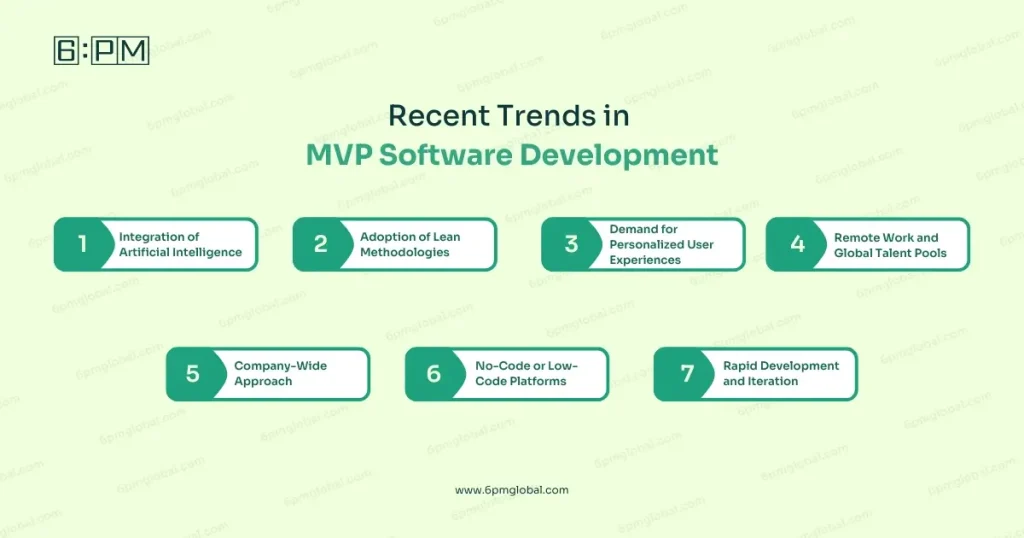
Integration of Artificial Intelligence
AI is a big part of MVPs, helping products to automate tasks and offer personalized user experiences. For example, even in the earliest version, an MVP chatbot can use AI to learn from user interactions and get better over time.
Adoption of Lean Methodologies
Developers are using lean methodologies to avoid unnecessary features and focus on what users actually need. In this way, they can launch quickly, get real feedback, and improve the product without wasting time or resources.
Demand for Personalized User Experiences
Even MVPs now try to make experiences feel customized to each user, which makes engagement right from the start. Whether it’s personalized recommendations or customizable interfaces, it makes the product more appealing from the start.
Remote Work and Global Talent Pools
Remote work has opened up access to a global pool of talent, allowing teams to collaborate across different time zones. It helps in speeding up MVP development and often reduces costs without compromising quality.
Company-Wide Approach
MVP development is no longer limited to a single team or department; it’s becoming a company-wide strategy. Organizations are aligning their efforts to ensure MVPs scale well and provide value across different business areas.
No-Code or Low-Code Platforms
Platforms like Bubble and Webflow make it easier for non-developers to create functional MVPs without writing code. This trend is great for startups or individuals who want to quickly test ideas without a big tech budget.
Rapid Development and Iteration
Time is really important in MVP development. Teams are building, testing, and improving products in shorter cycles to get to market faster and iterate based on real-world feedback.
Stages of Custom MVP Software Development Services
Custom MVP software development services follow a series of stages to ensure a successful product launch. Here are the key stages you need to know:

Ideation and Planning
In this initial stage, you understand your business vision, target audience, and goals. Conduct thorough market research to identify opportunities and challenges. Develop a strategic plan to guide the entire MVP development process.
Well, this ensures that your MVP aligns with your business objectives and market demands.
Feature Prioritization
Determine the core functionalities your MVP needs. Identify the “must-have” features that provide the most value to your users.
Also, focus on the essential elements that solve your users’ problems and meet their needs. This prioritization helps in creating a product that is both valuable and efficient.
Design and Prototyping
Create user-friendly and visually appealing interfaces (UI) and experiences (UX). Develop interactive prototypes that realistically represent the product’s functionality.
The stage is needed to visualize how users will interact with your MVP and ensure a seamless user experience.
Development and Testing
Use modern technologies to build a robust and scalable MVP. Follow agile methodologies to enable rapid development cycles and continuous testing.
This approach makes sure that your product is built efficiently and meets high-quality standards, minimizing the risk of errors and issues.
Launch and Feedback Gathering
Deploy your MVP to your target audience and set up analytics and feedback mechanisms. Gather user insights to understand how your product is performing and identify areas for improvement.
Well, this feedback is vital for refining your MVP and making data-driven decisions for future development.
Maintenance and Support
Provide ongoing support to resolve any performance issues and ensure the MVP remains functional and effective. Plus, regular updates and maintenance keep your product running smoothly and address any emerging user needs or technical challenges.
Benefits of Custom MVP Software Development
Custom MVP software development offers several benefits for businesses. Here’s how it can help your company:
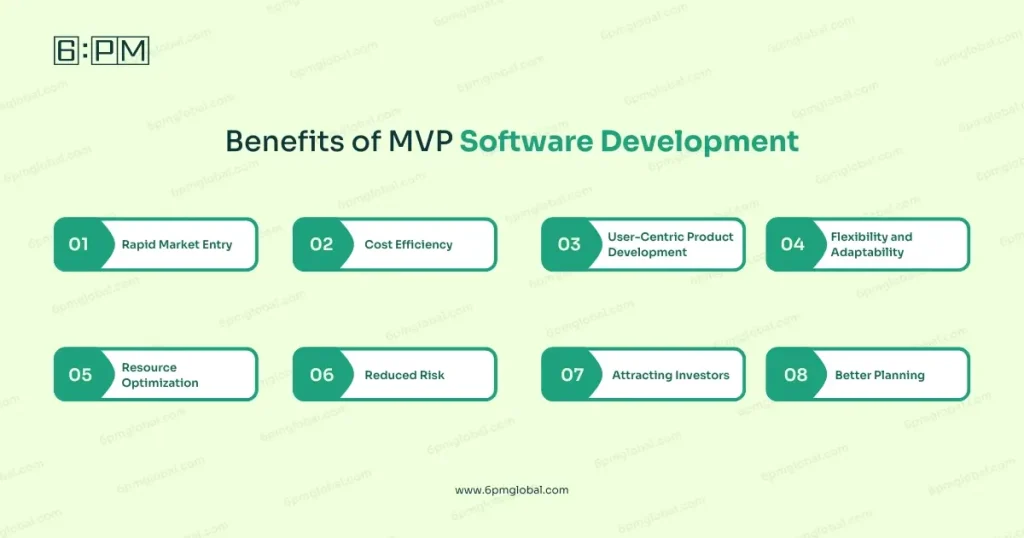
Rapid Market Entry
By focusing on essential features, you can launch a functional product quickly. This gives you a competitive edge by getting your product to market faster.
Moreover, early entry allows you to establish your presence and start building a user base ahead of competitors.
Cost Efficiency
Custom MVP software development reduces initial development costs by concentrating on the most critical features. The approach saves you money and resources, allowing you to invest in other areas of your business.
Also, it ensures you get a working product without unnecessary expenses. For example, if a full-phase product costs 200K USD, developing an MVP might cost only 50K USD. This approach can save you 75% of the development budget.
User-Centric Product Development
Gathering user feedback during the MVP stage ensures the final product meets market demands. This user-centric approach helps you create a product that resonates with your target audience.
By understanding user needs, you can make informed improvements.
Flexibility and Adaptability
Custom MVP software development allows for incremental improvements based on user feedback. The flexibility means you can adapt your product to changing market conditions and user preferences.
It ensures your product remains relevant and valuable over time as well.
Resource Optimization
By focusing on crucial aspects of the product, you ensure high-quality outputs. This resource optimization means your development team can work more efficiently and effectively.
Therefore, it leads to a better product and maximizes the use of available resources.
Reduced Risk
Custom MVP software development validates product ideas before full-scale development, identifying potential issues early. The reduced-risk approach helps you avoid costly mistakes and ensures your product is on the right track. It provides a safer path to market.
Attracting Investors
A working MVP demonstrates the viability and potential of your new product. This proof of concept helps secure funding from investors who see the value in your idea.
Also, it shows that you have a solid plan and a product worth investing in.
Better Planning
Developing an MVP provides valuable insights for planning and developing subsequent versions.
This better planning ensures that future iterations of your product are more refined and targeted. It gives you a clear roadmap for continued growth and improvement too.
Services to Look for to Develop Custom MVP Software
When choosing a custom MVP software development company, look for these essential services to ensure a successful project:

Consulting
Look for a company that offers thorough business and technology analysis. They should understand your client’s requirements and project goals.
The service makes sure that your development aligns with your business vision and market needs. It also provides a strong foundation for your MVP.
MVP UI/UX Design
Ensure the company provides a detailed evaluation and an initial product development plan. They should create interactive prototypes and offer modern UX/UI design.
This service helps visualize your product and ensures it is user-friendly and appealing.
Custom MVP Development
Choose a company that conducts business analysis and competitor research. They should support you throughout all development stages. The complete service ensures your MVP is well-researched, competitive, and aligns with your business strategy.
Development Support
Last, but not least, look for ongoing infrastructure support for new and existing MVPs. The company should fix bugs and modernize features as needed.
Well, this service confirms your product remains functional, up-to-date, and capable of meeting user demands over time.
Proper Custom MVP Development Process
Developing a proper custom MVP involves several steps to make sure your product meets market needs and business goals. Let’s see how you can do it:
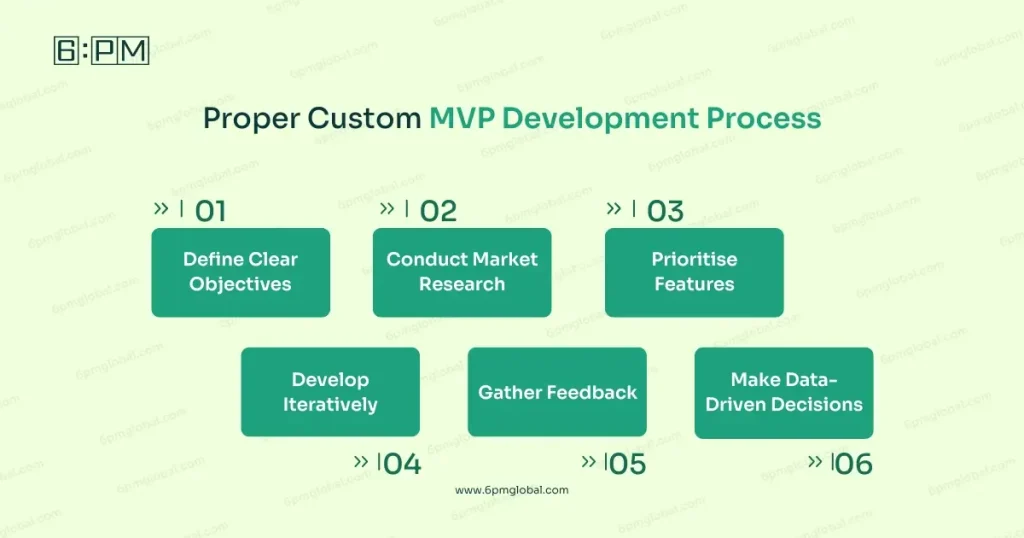
Define Clear Objectives
Start by understanding your business goals and what you aim to achieve with the MVP. Clearly defined objectives will guide your development process and keep your team focused. Note that knowing your end goal helps you make strategic decisions throughout the project.
Conduct Market Research
Identify your target audience and understand their needs and preferences. Conduct thorough market research to gather insights about your potential users.
Well, this step is necessary to ensure your MVP addresses real problems and has a viable market demand.
Prioritize Features
Focus on the core functionalities that will provide the most value to your users. Determine the essential features that solve the primary problems your target audience faces.
Also, prioritizing features ensures you deliver a product that meets user needs without unnecessary complexity.
Develop Iteratively
Use agile methodologies to allow for flexibility and continuous improvement. Develop your MVP in small, manageable increments and adjust based on feedback and changing requirements.
This iterative approach helps address issues quickly and improve the product progressively.
Gather Feedback
Deploy your MVP to real users and collect their feedback on its performance and usability. Set up mechanisms to gather user insights and understand their experiences with your product.
Remember that feedback is important for identifying areas for improvement and validating your product’s concept.
Make Data-Driven Decisions
Use the feedback and analytics collected from users to make informed decisions about future development. Analyze the data to understand user behavior, preferences, and pain points.
Data-driven decisions make sure that your subsequent development efforts are aligned with actual user needs and market trends.
Tips for Custom MVP Software Development
Here are some tips for successful custom MVP software development services for startups:
- Stay User-Focused: Always keep the end-user in mind when the developer is developing the MVP and make sure it meets their needs.
- Be Flexible: Be ready to pivot based on user feedback and market demands, adjusting your approach as necessary.
- Optimise Resources: Allocate resources efficiently to ensure high-quality outputs without overspending or wasting time.
- Test Rigorously: Conduct continuous testing to maintain quality and catch issues early, ensuring a reliable product.
- Communicate Clearly: Ensure transparent communication with stakeholders and development teams to keep everyone aligned and informed.
- Set Realistic Goals: Establish achievable milestones and timelines to keep the project on track and manage expectations effectively.
Drawbacks of Custom MVP Software Development
Now let’s find out some drawbacks of this software:
- Limited Features: An MVP includes only the essential features, which may not fully satisfy all user needs.
- Initial User Perception: Users might judge the product based on its initial limited functionalities.
- Iterative Process: Requires continuous improvements and adjustments, which can be resource-intensive.
- Risk of Misalignment: If not properly planned, the MVP might not align with the final product vision.
Case Study on MVP Software Development
The Dropbox Story
In 2007, Drew Houston came up with Dropbox because he kept forgetting his USB drive. He imagined an easy way to store and access files online, from anywhere.
Instead of building the whole product right away, Drew made a short video showing how Dropbox would work. The video explained the idea simply: you could save files online and access them on any device.
People loved it! The video generated tons of interest, proving the idea was worth pursuing. Drew and his team then built Dropbox, and today, it’s one of the most popular cloud storage tools, used by millions.
What We Can Learn:
- Start small: Test your idea without building everything.
- Solve real problems: Dropbox focused on something everyone struggled with file access.
- Listen to users: The feedback from the video guided what they built next.
Dropbox shows that with a great idea and a smart MVP, you can create something truly game-changing!
Final Verdict
So, we can say that custom MVP software development is a smart way for businesses to quickly validate ideas, reduce risks, and make the most of resources.
By focusing on essential features and gathering real-world feedback, you can make informed decisions, attract investors, and improve your chances of success. Though challenges exist, the flexibility and adaptability of custom MVPs offer significant benefits, ensuring long-term growth and market relevance.
Therefore, partnering with a reliable development company is needed. They provide complete services and expertise, laying a solid foundation for future product development and business growth. This basically sets you up for continued success.
FAQs
How to create a software MVP?
The steps for creating a software MVP-
1. Ideation and Planning
2. Feature Prioritization
3. Design and Prototyping
4. Development and Testing
5. Launch and Feedback Gathering
6. Maintenance and Support
Is MVP a prototype?
MVP is not a prototype. An MVP is the simplest version of your product that actually works. It’s released to real users to see if they like it and gather feedback.
In short:
1. Prototype testing ideas.
2. MVP testing the market with a basic, working product.
Can custom MVPs attract investors?
Yes, a well-developed MVP demonstrates the viability and potential of your new product. It provides proof of concept that can attract investors by showing that your idea has been tested and has market demand, increasing their confidence in your project.
What technologies are commonly used in custom MVP development?
Technologies vary based on the project’s requirements, but commonly used ones include front-end frameworks like React or Angular, back-end technologies like Node.js or Django, and databases like MongoDB or PostgreSQL. The choice depends on the specific needs of the MVP.
How do agile methodologies benefit custom MVP development?
Agile methodologies promote iterative development, allowing for flexibility and continuous improvement. The approach helps quickly address issues, incorporate user feedback, and adapt to changing requirements, ensuring a more efficient and effective development process.