


Did you know that 90% of tech startups fail within their first year? Despite this, the appeal of creating innovative solutions keeps entrepreneurs striving. It’s because a tech startup can change industries and solve real problems, offering immense growth opportunities.
How to start a tech startup properly in this case? Of course, you need a strong idea, a solid business plan, funding, and a dedicated team. You also have to execute your plan with precision and perseverance.
Seems difficult? No worries, read the full guide to learn the essential steps, avoid common pitfalls, and get inspired by successful tech startup examples. This guide will equip you with the knowledge to confidently embark on your startup journey.
Let’s get started!
What is a Tech Startup?
A tech startup is a company that creates and sells technology products or services. These businesses often work in areas like software, hardware, biotech, and AI.
Moreover, they are known for their innovation, scalability, and high growth potential. Tech startups aim to bring new ideas to market quickly and can grow rapidly.

According to Statista, the global tech startup ecosystem was valued at $3.8 trillion in 2020. This shows the impact and opportunity in this field. Thus, the main goal to know how to start a tech startup is to solve real-world problems with technology. It offers unique solutions that can be scaled to meet the demands of a larger market as well.
What Makes a Tech Startup Different from a Traditional Business?
Tech startups are unique compared to traditional businesses in different key ways. They focus on rapid growth and innovation, often using new technology to solve problems.
Here are some of the main differences:

Tech Innovation
Tech startups prioritize innovative solutions to solve problems. They use unique technology to create new products and services. This focus on innovation sets them apart from traditional businesses that may rely on established methods and products.
Scalability
These startups are designed to scale rapidly. They use technology to expand their market reach with minimal incremental costs. It means you can grow quickly and efficiently, often reaching a global market much faster than traditional businesses.
Funding
A tech startup company typically wants venture capital and other forms of investment. The funding is used to improve rapid growth and development. Unlike traditional businesses, which may rely on profits or loans, tech startups often depend on investors looking for high returns.
Risk and Reward
Higher risk is inherent in tech startups, but the potential rewards are significant. While many tech startups fail, those that succeed can achieve massive growth and profits. This high-risk, high-reward thing differs greatly from the more stable but often slower-growing traditional businesses.
Adaptability
Lastly, a tech company is highly adaptable and responsive to market changes. They can adapt quickly based on feedback and new information. This flexibility allows them to seize new opportunities and address challenges more effectively than traditional businesses, which may be more strict in their operations.
How to Start a Tech Startup: 16 Excellent Steps
Knowing how to start a tech startup requires careful planning and execution. Here are 16 detailed steps to guide you on how to start a tech company:

1. Identify a Problem and Passion
First, identify a problem you are passionate about solving. This passion will be the driving force behind your startup’s success.
Additionally, consider issues that resonate with you and have a significant impact. Your commitment to this problem will help you stay motivated during challenging times and inspire your team to work towards a common goal.
2. Find a Tech Cofounder or Fractional CTO
It’s important to have someone with technical expertise on your team. A tech cofounder can bring in the necessary skills and insights for product development.
Alternatively, hiring an affordable fractional CTO can provide you with the technical leadership and guidance needed to make informed decisions. Both options ensure your startup company has a solid technical foundation, which is essential for building and scaling your product effectively.
3. Conduct Market Research
Then, understand your target audience, market trends, competition, and potential demand for your solution. Market research helps you validate your idea and identify opportunities and threats.
You should also gather data through surveys, interviews, and industry reports. The research will provide insights into customer needs, preferences, and behaviors, helping you customize your solution effectively.
4. Register Your Business
Now, you must choose a legal structure, register your company name, and secure any required licenses or permits. Selecting the right structure, such as a sole proprietorship, partnership, or corporation, is essential for liability protection and tax purposes.
For instance, if you are in the US, it is advisable to register your business in Delaware, as it is considered a tax haven. Delaware offers favorable laws for businesses and has a simple registration process.
Here, you have two main options for legal structure: LLC or INC. It is recommended to start with an LLC as it is easier to manage and provides flexibility.
Moreover, register your company name to ensure it is unique and protected. You can reserve your business name through the Delaware Division of Corporations Name Reservation page. Registering the name with the US Trademark Office is also wise, as it costs less than $100.
This ensures that no one else can use your business name, providing an extra layer of protection.
5. Build a Prototype or MVP
Develop a Minimum Viable Product (MVP) to test your concept and gather user feedback. An MVP includes the core features necessary to solve the problem and allows you to validate your idea with minimal resources.
Plus, collect feedback from early users to identify areas for improvement and iterate on your product based on this input.
6. Develop Your Idea
Create a detailed business plan outlining your solution, target audience, value proposition, and revenue model. Your business model should include market analysis, competitive analysis, marketing strategy, operational plan, and financial projections. Plus, prepare a pitch deck to present your idea precisely to potential investors and partners. This document will serve as a map for your startup and a tool to attract investors and partners.
7. File for Intellectual Property Copyright
Protect your startup idea by filing for intellectual property copyright. This step is important to ensure your innovative concepts and products are legally protected against infringement.
Securing IP protection also prevents others from using, copying, or selling your ideas without permission. This legal safeguard not only protects your work but also adds value to your startup.
So, make sure to file for copyright as early as possible in your development process to establish clear ownership and avoid potential legal issues in the future.
8. Assemble a Team
Build a skilled team that shares your vision, including developers, designers, marketers, and other essential roles. A diverse team with complementary skills is vital for your startup’s success.
Look for individuals who are passionate about your mission and can contribute to different aspects of your business, from product development to marketing and sales. In this case, 6PM can surely help you. 6pm Global helps tech startups build strong teams and offers technology support. They provide fractional CTO service to guide your technical strategy and growth, ensuring your startup has the right expertise and resources to thrive.
9. Secure Funding
Explore various funding options such as bootstrapping, angel investors, venture capital, crowdfunding, and government grants.
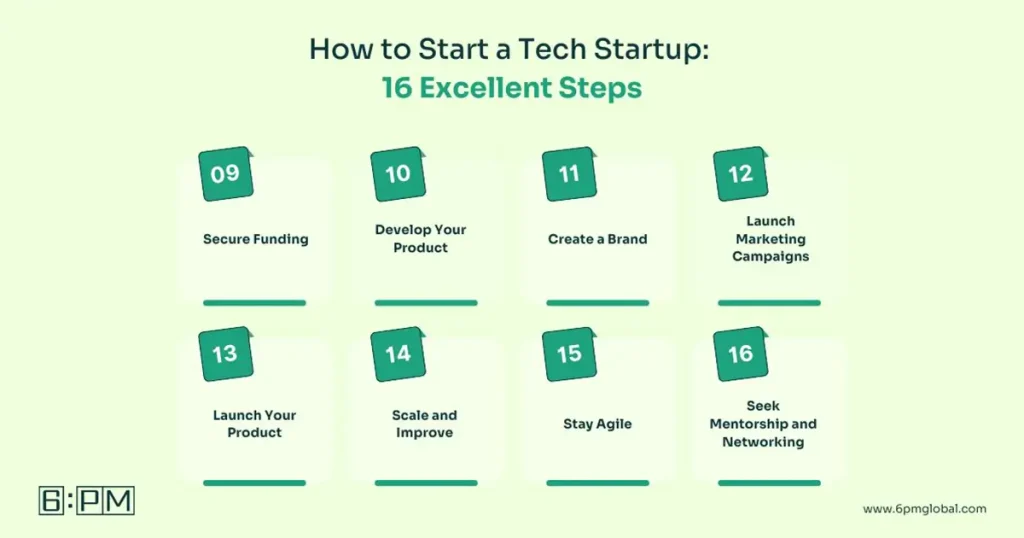
Remember that each funding source has its pros and cons. Prepare a compelling pitch and business plan to attract investors. You can use LinkedIn and Crunchbase to find potential investors by searching for relevant industry connections and reaching out with personalized messages.
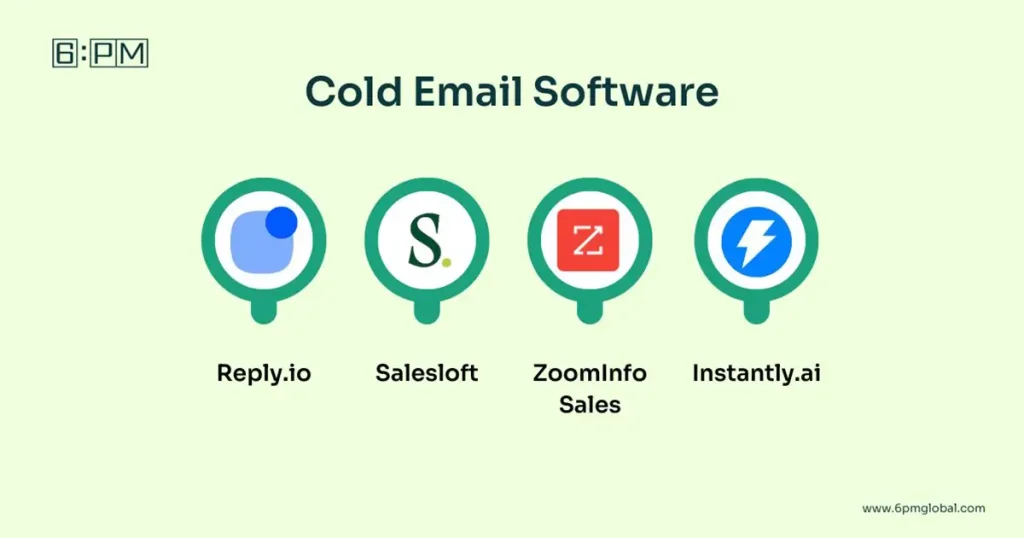
To mail them, you can try cold email software such as Reply.io, Salesloft, ZoomInfo Sales, Instantly.ai and more.
You can also search Google for “angel investor network” or “venture capitalist companies near me” to find local opportunities. And when you get it, be ready to explain how you will use the funds and the expected return on investment.
10. Develop Your Product
Develop your product by focusing on creating a functional and polished item, continually testing and refining it based on user feedback. Aim to build a product that meets customer needs and exceeds their expectations.
Moreover, you must invest in quality assurance and user experience design to ensure reliability and user-friendliness. Remember, creating an MVP should take less than six months, while full-scale product development can take 12-36 months.
Hence, ensure you have the funding to support your team throughout this process.
11. Create a Brand
Before creating a company, you need a name that reflects your brand. Develop a strong brand identity, including a memorable name, logo, and online presence. If you want to spend less, you can do it yourself. In that case, try Canva or Pixlr.
On the other hand, if you need professional help, invest in professional design services to create a cohesive brand identity.
Remember that your brand represents your startup’s values and vision. So, invest in professional design services to create a cohesive brand identity. Additionally, a strong brand helps you stand out in the market and builds trust with your audience.
12. Launch Marketing Campaigns
Develop a complete marketing strategy that includes online presence, content marketing, social media and SEO. Note that, optimizing your website for search engines is crucial to increasing visibility.
Here, you can use two types of SEO: organic SEO, which involves creating valuable content without direct costs, and Paid SEO, which includes PPC (pay-per-click) marketing.
Additionally, social media platforms are another key aspect of building a community around your brand. Tools like Buffer can help automate your social media efforts for 2-6 months, making it easier to maintain a consistent online presence.
Furthermore, you need the right fractional CMO to help you with effective marketing. It’s because Effective marketing helps you reach your target audience and generate interest in your product.
So, create engaging content, optimize your website for search engines, and use social media platforms to build a community around your brand.
13. Launch Your Product
Through marketing efforts, create buzz around your product launch and gather initial user feedback. Plan a launch event or campaign to generate excitement and attract early adopters.
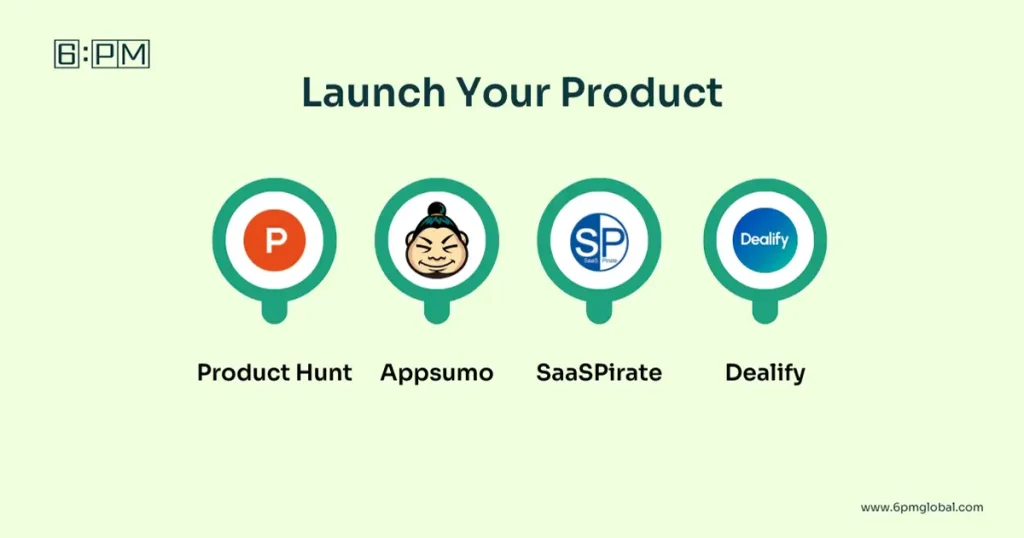
For more convenience, try Product Hunt, Appsumo, SaaSPirate, Dealify and more. You can closely monitor your user feedback here and be prepared to make quick adjustments based on their input. That’s the key!
14. Scale and Improve
Continuously collect user feedback and data to make necessary improvements and add new features. Plus, update your product regularly to fix bugs, enhance performance, and introduce new functionalities.
As you gain traction, focus on scaling your operations by expanding your customer base and optimizing processes. Increase production capacity, improve customer support, and streamline operations to support growth.
Also, use data to identify areas for improvement and invest in necessary technology and resources.
15. Stay Agile
Embrace agile methodologies to adapt quickly to changes and keep your startup competitive. Agile practices involve successive development, continuous feedback, and the flexibility to change direction as needed.
For example, you can use Scrum.org, Kanban, Crystal, DSDM and many more. These will allow you to respond more effectively to market trends, customer needs, and technological advancements.
16. Seek Mentorship and Networking
Last but not least, use networks, accelerators, and incubators for mentorship, resources, and connections. Mentors can provide valuable advice, support, and industry insights. Plus, you can use platforms like LinkedIn and ADPList, which are great for finding mentors and networking opportunities.
Hence, networking with other entrepreneurs and industry professionals can open doors to partnerships, collaborations, and funding opportunities. To expand your network, participate in startup events and join relevant organizations as well. Download a comprehensive Tech Startup Business Plan template from 6PM Global to streamline your planning process today.
Some Tips for Starting a Tech Startup
To create a tech startup, you must carefully consider and plan strategically. Following some essential guidelines and avoiding common mistakes is needed to increase your chances of success. Let’s find out some points to keep in mind:
- Knowing your market is essential. Talking to family and friends isn’t enough; use professional surveys and industry analysis.
- Keep your MVP simple. Focus on core features that solve the main problem.
- Ensure sufficient funding. Plan for initial development and operational costs.
- Address legal and compliance issues early to avoid future problems.
- Listen to customer feedback. Iterate and improve based on user input.
Examples of Successful Tech Startups
Successful tech startups can provide valuable inspiration and insights for aspiring entrepreneurship. By examining how these technology companies identified opportunities, developed innovative solutions, and scaled their operations, you can better understand what it takes to succeed in the tech industry.
Let’s see some examples of tech startups that have made amazing impacts in their respective fields:

Dropbox
Started as a simple solution for file sharing and storage, Dropbox has grown into a household name in cloud storage. In its early stages, Dropbox was founded by Drew Houston and Arash Ferdowsi in 2007 after Drew realized he kept forgetting his USB drive. They initially launched the product on Hacker News and used a simple demo video to attract early adopters. They also focused on the MVP and gained momentum.
Therefore, Dropbox’s user-friendly interface and great features have set it apart in the market.
Airbnb
Transforming the hospitality industry, Airbnb provides a platform for homeowners to rent out their properties.
When Airbnb started, it was a small website created by Brian Chesky, Joe Gebbia, and Nathan Blecharczyk in 2008 to offer air mattress rentals in their apartment during a conference. They initially struggled to gain traction, and even they used to go to houses and take photos themselves because hosts were not doing that.
Eventually, they found success by targeting events with high demand for lodging. The startup has made travel more affordable and personalized, allowing people to stay in unique places worldwide. Thus, Airbnb’s success lies in connecting hosts and guests seamlessly and offering diverse lodging options.
Uber
Uber transformed the transportation industry with its ride-hailing app, offering convenience and new economic opportunities.
In its early days, Uber was founded in 2009 by Garrett Camp and Travis Kalanick as a small startup providing a black car service in San Francisco. They tested the service with just a few cars and used word-of-mouth marketing to attract their first users.
By connecting drivers with passengers via a mobile app, Uber made getting a ride faster and easier. Now, it has expanded globally, introducing additional services like Uber Eats that enhanced its footprint in the tech and transportation sectors.
Final Thoughts
Starting a tech startup is a challenging yet rewarding journey. By following the steps in this guide on how to start a tech startup, avoiding common mistakes, and learning from successful startups, you can handle the process of launching your tech venture.
Just stay focused on your goals, be strong in the face of challenges, and keep coming up with new ideas. With careful planning, dedication, and a strong team, you can build a tech startup that makes a big impact in your chosen industry.
Keep learning and adapting; your startup can thrive and grow in the ever-changing tech world. Good luck!
FAQs
How do I handle competition?
Stay aware of your competitors and continuously innovate to offer unique solutions. Focus on your strengths and understand your market to differentiate your product. Also, adapt to changes and improve based on feedback and market trends.
What is bootstrapping?
Bootstrapping means funding your startup with your own savings or revenue from initial sales without external investment. It allows you to maintain control over your tech business but may limit growth compared to funded startups.
How do I maintain a work-life balance as a founder?
Set clear boundaries, prioritize tasks, and delegate responsibilities. Take breaks and make time for personal activities to avoid burnout. Balancing work and personal life is essential for your well-being and long-term success.