


The role of a Chief Technology Officer (CTO) is necessary for any startup trying to scale its technology. Also, Studies show that 23% of startups fail due to team issues, so hiring the right CTO is very important to your company’s success.
Well, hiring a CTO includes defining your company’s technical needs, evaluating candidates’ skills and experience, and ensuring they align with your vision. So, look for a leader who can effectively build and manage a tech team.
Want to know more? Then, read the full blog to explore the complete hiring process, including key responsibilities, skills to look for, and expert tips to ensure you find the right CTO for your startup’s journey.
Let’s buckle up!
Why is a CTO Important?
A Chief Technology Officer (CTO) plays a major role in driving a startup’s technical and business success. Let’s see five important reasons why a CTO is essential:
Aligns Technology with Business Goals
A good CTO makes sure that the technology strategy supports your business objectives. They work closely with other leaders to ensure your company’s technical direction aligns with its vision. He helps to achieve both short-term and long-term goals effectively as well.
Drives Innovation
Then, a CTO keeps the company ahead by using new technologies and innovative solutions. They constantly explore emerging trends, tools, and practices to keep your business competitive.
Plus, the CTO may help you adopt the latest advancements that can improve your products and services.
Improves Product Architecture
A CTO is responsible for building a solid product architecture. They design and oversee scalable, efficient systems that can grow with the company. It ensures that your products are reliable, secure, and capable of handling increasing demand as your business expands.
Leads and Manages the Engineering Team
The CTO is not only a technical expert but also a leader. They manage the engineering team, set clear goals, and guide the team toward achieving technical excellence.
Moreover, a strong CTO builds a cohesive and motivated team that drives innovation and maintains high standards.
Reduces Risk and Ensures Security
In a tech world, security risks are always present. Here, CTO ensures that your company’s technology infrastructure is safe and compliant with industry standards.
Also, they develop strategies to minimize risks, protect data, and ensure that all technology processes run smoothly and securely.
Key Responsibilities of a Chief Technology Officer
A Chief Technology Officer wears many hats, and their responsibilities are critical to a startup’s success. Here are the CTO roles below:
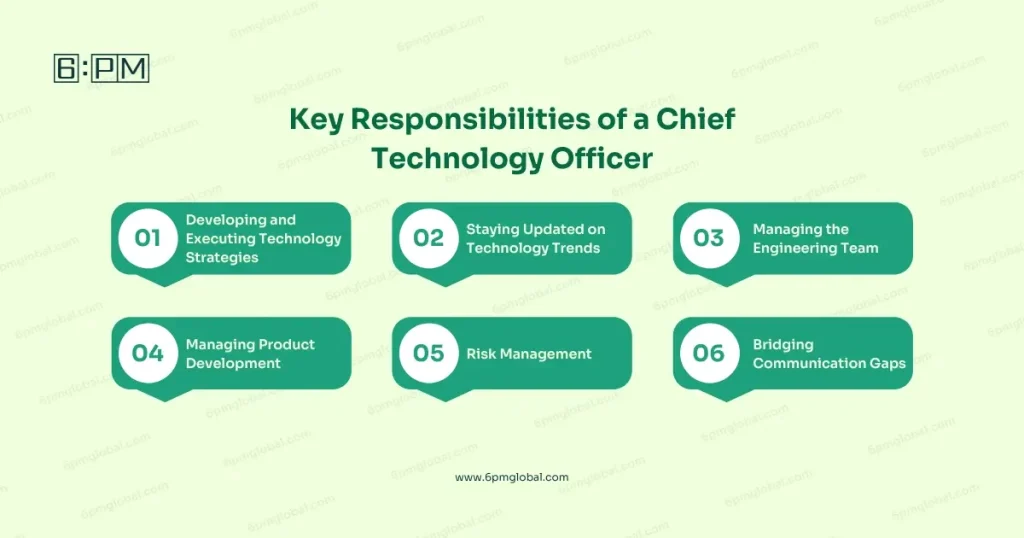
Developing and Executing Technology Strategies
A CTO creates and implements the company’s technology roadmap. They ensure that the technology strategy supports both immediate business needs and long-term goals.
This means choosing the right tools, platforms, and practices that align with the company’s vision and help the business grow efficiently.
Managing the Engineering Team
The CTO is responsible for leading the engineering team. They hire, mentor, and oversee the technical staff, making sure they follow best practices and meet company standards.
Well, by setting clear goals and expectations, the CTO makes sure the team works smoothly and delivers high-quality work.
Managing Product Development
A key responsibility of a great CTO is to work with product managers in designing and shaping the product roadmap. They plan how the product will be built, what features it will have, and how it will evolve.
Thus, their focus is on creating a scalable, secure, and user-friendly product that meets market needs.
Risk Management
The CTO identifies potential risks related to technology and takes steps to reduce them. It includes data security, system downtime, and compliance issues. They implement solutions to protect the company from technical failures, security breaches, and other risks that could disrupt operations or harm the business.
Bridging Communication Gaps
One of the CTO’s important roles is to act as a bridge between the technical team and non-technical stakeholders. They ensure that everyone, from executives to investors, understands how technology decisions support the business.
Hence, it helps align the technical direction with the company’s overall goals and ensures smooth team communication.
Staying Updated on Technology Trends
The technology framework changes rapidly, and it’s the CTO’s job to keep the company competitive by staying informed on the latest advancements. They research new technologies, trends, and tools that can be applied to improve the company’s products, services, and internal processes.
This ensures the business stays ahead in the market too.
Hard Skills of a CTO for a Startup
A Chief Technology Officer must have a range of technical abilities to improve a startup’s success. Here are some of the essential hard skills a CTO should possess:
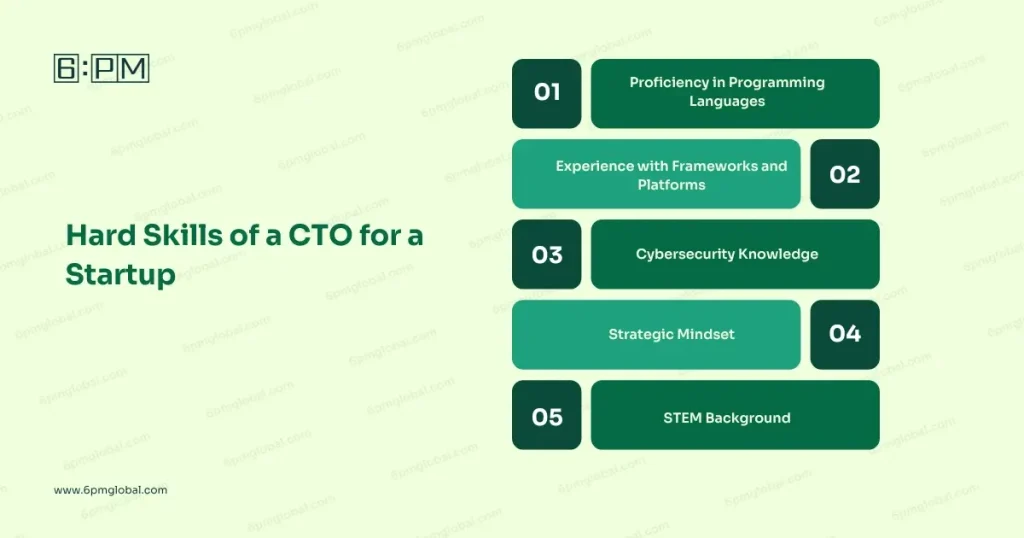
Proficiency in Programming Languages
A CTO should be highly skilled in programming languages relevant to your business, such as JavaScript, Python, or SQL. Their ability to code ensures they can guide the development team and make informed technical decisions.
Experience with Frameworks and Platforms
CTOs must be familiar with frameworks such as React, Node.js, or cloud platforms like AWS. Understanding these tools allows them to build efficient systems and choose the right technologies for the company’s needs. Also, it ensures scalability and reliability in product development.
Cybersecurity Knowledge
A strong CTO understands cybersecurity and how to protect the company’s digital assets. They create strategies to prevent security breaches and safeguard sensitive data. Well, the expertise is needed for reducing risks and ensuring compliance with industry standards.
Strategic Mindset
CTOs need more than just technical knowledge; they must be able to think strategically. They are responsible for developing long-term technology plans that align with the company’s vision.
This includes identifying trends and technologies that will drive future growth and innovation.
STEM Background
A solid foundation in science, technology, engineering, or mathematics (STEM) is important for a CTO. This background gives them the technical expertise and problem-solving skills necessary to tackle complex challenges and lead the company’s technological efforts effectively.
Soft Skills of a CTO
In addition to technical expertise, a CTO must have strong, soft skills to lead teams and collaborate properly. Let’s see some soft skills a CTO should have:
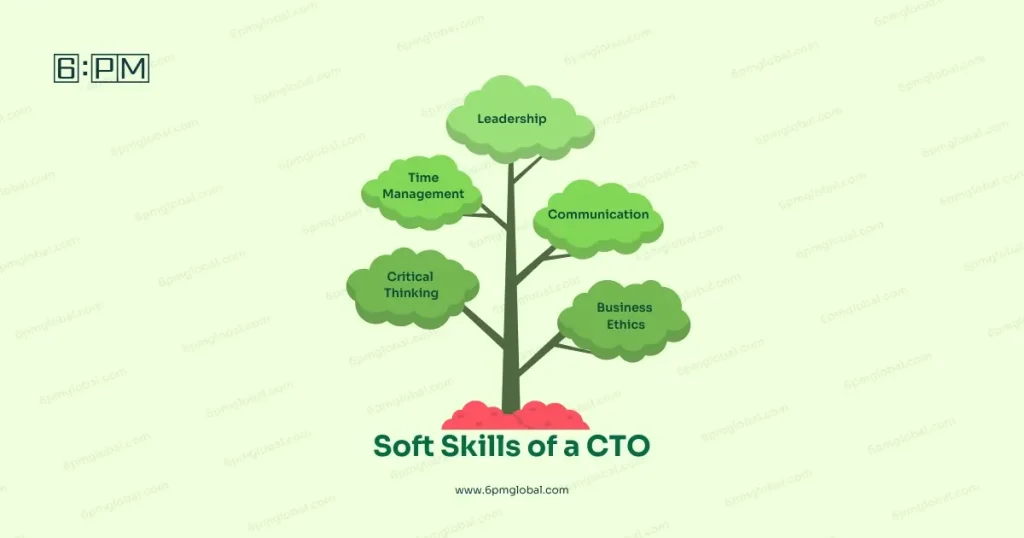
Leadership
A CTO needs to inspire, motivate, and guide their team. Effective leadership helps drive productivity and fosters innovation. They must create a positive work environment, set clear goals, and provide the support their team needs to succeed.
Communication
CTOs must be able to explain complex technical concepts in simple terms to non-technical stakeholders, such as executives or investors. Clear communication ensures that everyone is aligned and understands how technology decisions impact the business. This makes collaboration smoother across departments.
Time Management
Balancing short-term and long-term goals is a key skill for a CTO. They must manage time effectively to ensure projects are completed on schedule without sacrificing quality.
Remember that good time management helps meet business deadlines and keeps the company on track toward its objectives.
Critical Thinking
A CTO needs to be a strong critical thinker. This means being able to analyze complex problems, assess different solutions, and make sound decisions under pressure. Their ability to think clearly in challenging situations helps steer the company toward the best technical outcomes.
Business Ethics
Acting with integrity and transparency is essential for a CTO. They must set an ethical example for the tech team by making responsible decisions and maintaining honesty in all aspects of their role.
Well, a strong sense of business ethics builds trust and supports a healthy company culture.
Best Practices for Hiring CTOs
Hiring the perfect CTO is challenging, and it requires thoughtful planning. Here are some tips to help you find the best fit:
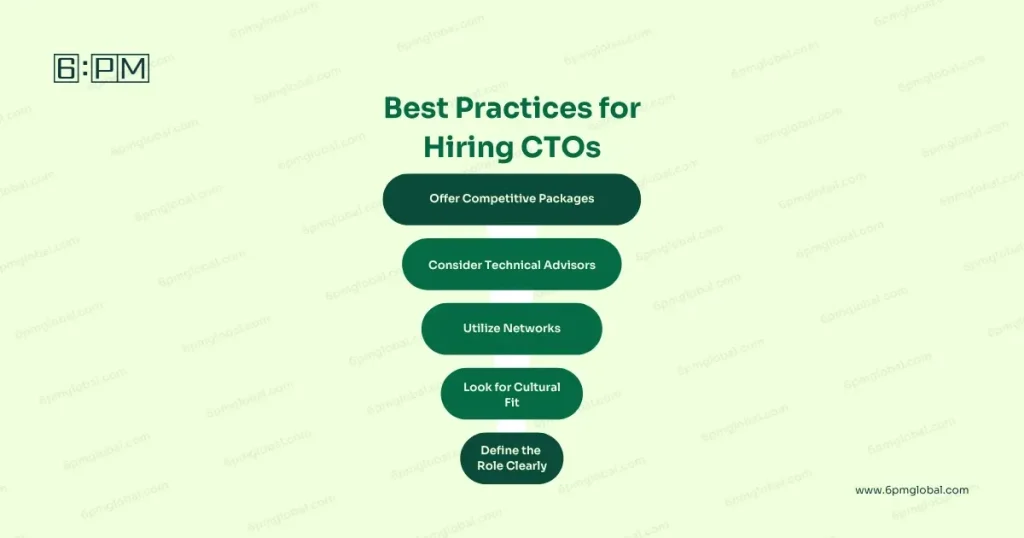
Define the Role Clearly
Clearly outline the skills, experience, and responsibilities you need in a CTO. If your company is in the growth phase, consider a CTO with experience scaling tech teams and managing large projects.
So, a well-defined role ensures you attract candidates who are not only technically skilled but also align with your company’s current and future needs.
Look for Cultural Fit
The CTO will be a key leader, so finding someone who shares your company’s values is essential. Beyond technical expertise, they should fit into your company culture and work well with the existing team.
A CTO who aligns with your mission and values will contribute more effectively to both leadership and the overall success of your startup.
Utilize Networks
Use platforms like LinkedIn, AngelList, and specialized tech communities to find potential candidates. Networking through industry events, online forums, and personal referrals can also help you discover tech talent that isn’t actively job hunting.
Thus, engaging with various sources increases your chances of finding a CTO with the right skills and experience.
Consider Technical Advisors
If you’re not ready to hire a full-time CTO, bringing on a technical advisor can provide interim support. Advisors can help with the technical decisions, assess your tech needs, and guide product development. For that, you can contact us cause we provide technical advisory services along with a fractional CTO, who can guide and help you to build the right technology stack for your business.
This approach allows you to gradually move toward hiring a full-time CTO while ensuring your tech strategy stays on track.
Offer Competitive Packages
To attract top talent, offer a competitive compensation package that includes salary, equity options, and other benefits. Startups often use equity as a key incentive, so be prepared to offer a stake in the company.
Form your offer to match the candidate’s experience and the value they’ll bring to your business.
Hiring Process for a CTO: Step by Step
The process of hiring a CTO involves different steps to ensure you find the right person for your tech startup. Here’s the process if you ever need a CTO:
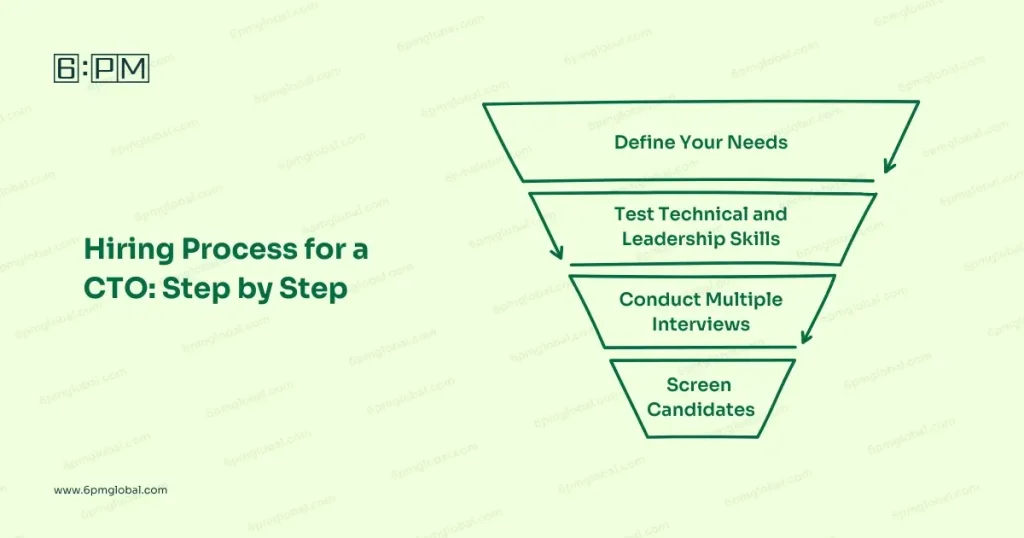
Define Your Needs
Before you begin searching, clearly define whether your startup needs a full-time, part-time, or fractional CTO. Depending on your growth stage, you might not require a full-time CTO initially.
Understanding your specific technical and leadership needs will help you tailor the search and find the right candidate who fits your company’s goals and development phase. This ensures a good match from the start as well.
Screen Candidates
Use platforms like LinkedIn, Wellfound, or other tech-focused communities to identify potential candidates. Evaluate them based on their experience, technical skills, and how well they align with your company’s vision and culture.
Looking at their past achievements, ability to lead teams, and familiarity with relevant technologies helps you narrow down a list of candidates who can best fulfill the role.
Conduct Multiple Interviews
Conducting multiple interview processes is essential for a C-level role like a CTO. That’s why you should start with initial conversations to understand their technical background and leadership experience, followed by more in-depth interviews with key team members.
These rounds of interviews should explore both their hard skills, such as coding or architecture, and soft skills like communication and problem-solving.
Test Technical and Leadership Skills
Incorporate technical assessments or use pre-employment testing tools like TestGorilla to objectively measure a candidate’s abilities. These assessments provide a clear picture of their technical capabilities.
Additionally, you can introduce leadership scenarios or problem-solving exercises to assess their ability to manage teams. Plus, you can make strategic decisions and handle real-world challenges your company may face.
CTO Interview Questions
When interviewing a CTO candidate, it’s important to ask questions to assess their technical expertise and leadership abilities. Here are some sample questions:
Technical Strategy and Decision-Making
- How do you balance short-term technical needs with long-term growth? This question helps you understand how they prioritize immediate business demands while keeping future scalability in mind.
- Describe a time you had to push back on an initiative due to technical limitations. Assess their decision-making when technical constraints interfere with business goals.
- How do you evaluate and decide which emerging technologies to adopt? This explores their ability to stay updated on new technologies and implement them effectively.
- What’s your approach to ensuring data security and compliance with regulations? This shows how they handle cybersecurity and regulatory concerns, which are critical for tech-driven businesses.
Leadership and Team Management
- How do you promote innovation within a technical team? Understanding their methods for encouraging creative problem-solving and new ideas can reveal their leadership style.
- How do you mentor and develop engineering talent in your team? This assesses their ability to grow and nurture technical talent, which is key to building a strong team.
- Describe a challenging situation where you had to align the technical team with the company’s overall goals. This helps evaluate how they balance team dynamics and business objectives.
- What steps do you take to ensure a diverse and inclusive technical team? This shows their approach to building a collaborative and inclusive work environment.
Problem-Solving and Crisis Management
- Can you describe a major technical failure and how you handled it? This question assesses their crisis management skills and how they react under pressure.
- How do you approach risk management in technology projects? Understanding their risk mitigation strategies gives insight into their forward-thinking and planning abilities.
Cost of Hiring a CTO
In the United States, a Chief Technology Officer’s average salary is around $303,870 per year, with a range usually falling between $267,799 and $347,717. These figures vary depending on factors such as location, experience, and industry.
In tech-heavy regions like San Francisco, salaries can be 25% higher than the national average. In addition to base pay, CTOs in startups often receive equity, which can significantly increase their total compensation.
Well, this provides a long-term financial stake in the company’s growth and success.
CTO Job Descriptions, Roles, and Responsibilities – Template
Phase 1: Early Stage
This CTO job description template is for startups in the early stages, offering a low base salary but a lucrative equity package.
Job Title
Chief Technology Officer (CTO)
Company Overview
At [Company Name], we’re disrupting [industry/niche] with [Product Name]. Our software solves [problem] by [unique solution], delivering [key benefits]. Proven by [evidence], we empower [industry/niche] professionals to excel. We plan to use [tech stack] for all our tech needs.
Tech Stack
[Include your tech stack, e.g., Machine Learning, Node.js, Google Cloud Platform (GCP), Next.js, AWS, Azure, Docker, Kubernetes, React.js, Angular.js, TypeScript]
Job Purpose
The Chief Technology Officer (CTO) will oversee the development and dissemination of technology across the organization. The CTO will lead the technology department, set the technical vision and strategy, and ensure the technology supports the company’s overall goals and initiatives.
Key Responsibilities
- Leadership and Strategy: Establish the technology department and foundational technology strategy. Collaborate with the founding team to align technology with business goals.
- Technology Development: Identify and develop key technologies that will form the basis of the company’s product or service offerings.
- Project Management: Manage initial IT projects, including the development of the Minimum Viable Product (MVP).
- Innovation: Research and apply innovative technologies that provide a competitive edge in early market entry.
- Team Management: Build a small, agile, and cost-effective technology team focused on rapid development and iteration.
- Budget Management: Operate within tight budget constraints, focusing on essential technology needs.
Qualifications
- Education: Bachelor’s or Master’s degree in Computer Science, Information Technology, or a related field.
- Experience: 5+ years in technology development roles with leadership experience.
- Skills: Strong leadership and decision-making skills.
Performance Goals
- Launch MVP: Successfully develop and launch an MVP within the first 6-12 months.
- Technology Validation: Achieve technical validation through user feedback, ensuring the product meets basic market needs.
- Initial User Acquisition: Reach early user adoption targets, demonstrating market interest and growth potential.
- Cost-effective Solutions: Implement strategies to optimize development processes and resource allocation.
Salary
[Your Package]
Apply Now
- Link: [Apply Here]
- Find Us: Website: [www.yourwebsite.com], Phone: +101234XXXX, Address: [Your office address]
Phase 2: Growth Stage
This CTO job description template is for startups in the growth stages seeking a dynamic leader to drive technical innovation and scalability.
Job Title
Chief Technology Officer (CTO)
Company Overview
Step into the future with [Company Name], your partner in [industry/niche] transformation. Our solution, [Product Name], addresses [problem] head-on with [unique solution]. Experience the difference as we deliver [key benefits], validated by [evidence]. Join us in empowering [industry/niche] professionals to succeed through innovation.
Tech Stack
[Include your tech stack, e.g., Machine Learning, Node.js, Google Cloud Platform (GCP), Next.js, AWS, Azure, Docker, Kubernetes, React.js, Angular.js, TypeScript]
Job Purpose
The Chief Technology Officer (CTO) will oversee the development and dissemination of technology across the organization. The CTO will lead the technology department, set the technical vision and strategy, and ensure the technology supports the company’s overall goals and initiatives.
Key Responsibilities
- Leadership and Strategy: Refine and expand the technology strategy to support growth. Begin to delegate more responsibilities as the team grows.
- Technology Development: Scale and improve existing technologies while exploring new expansion opportunities.
- Project Management: Oversee multiple, complex IT projects, ensuring they align with the company’s growth trajectory.
- Innovation: Foster a culture of innovation within the technology team, encouraging experimentation and risk-taking.
- Team Management: Expand the technology team, focusing on specialization and departmentalization.
- Budget Management: Manage a larger technology budget, strategically investing in technology to support scaling.
Qualifications
- Education: Bachelor’s or Master’s degree in Computer Science, Information Technology, or a related field.
- Experience: 8+ years with a proven track record in a startup environment.
- Skills: Strong leadership and decision-making skills.
Performance Goals
- Scale Technology: Enhance and scale the technology to handle increased user loads and integrate additional features.
- User Growth: Achieve significant user growth milestones, such as doubling or tripling the user base.
- Product Enhancement: Continuously improve the product based on user feedback and emerging market trends.
- Maximizing Cost Efficiency: Implement strategies to optimize resource use and ensure cost-effective solutions.
Salary
[Your Package], or Negotiable
Apply Now
Link: [Apply Here]
Find Us
Website: [www.yourwebsite.com]
Phone: +101234XXXX
Address: [Your office address]
Phase 3: Maturity Stage
This CTO job description template is for startups in the maturity stages seeking an experienced and strategic professional to optimize existing systems, streamline operations, and lead technological advancements aligned with long-term business goals.
Job Title
Chief Technology Officer (CTO)
Company Overview
Introducing [Company Name], a frontrunner in [industry/niche]. Through [Product Name], we’ve mastered [unique solution] to address [problem]. With a track record of [milestones/achievements], we continue to empower [industry/niche] professionals. Join us as we lead the industry with cutting-edge technology.
Tech Stack
[Include your tech stack, e.g., Machine Learning, Node.js, Google Cloud Platform (GCP), Next.js, AWS, Azure, Docker, Kubernetes, React.js, Angular.js, TypeScript]
Job Purpose
The Chief Technology Officer (CTO) will oversee the development and dissemination of technology across the organization. The CTO will lead the technology department, set the technical vision and strategy, and ensure the technology supports the company’s overall goals and initiatives.
Key Responsibilities
- Leadership and Strategy: Lead a large technology department, setting long-term visions and strategies that align with the company’s matured business goals.
- Technology Development: Oversee the development of cutting-edge technologies, ensuring the company stays at the forefront of technological advancements.
- Project Management: Direct complex, large-scale IT projects and technology integrations that solidify the company’s market leader CTO position.
- Innovation: Lead technological research and development efforts, establishing partnerships with search firms or other companies.
- Team Management: Oversee a large, diverse technology team, focusing on leadership development and strategic planning.
- Budget Management: Control a significant technology budget, investing in new technologies, research and development, and acquisitions.
Qualifications
- Education: Bachelor’s or Master’s degree in Computer Science, Information Technology, or a related field.
- Experience: 10+ years in IT and technology leadership roles, with extensive experience managing large teams and projects.
- Skills: Strong leadership and decision-making skills.
Performance Goals
- Innovation Leadership: Establish the company as a leader in innovation within its sector, pioneering new technologies or methodologies.
- Market Expansion: Prepare and begin executing plans for geographic and demographic market expansion.
- Strategic Partnerships: Forge partnerships and collaborations that enhance product offerings and market reach.
- Cost Efficiency: Implement strategies to optimize resource allocation and streamline processes.
Salary
[Your Package], or Negotiable
Apply Now
Link: [Apply Here]
Find Us
Website: [www.yourwebsite.com]
Phone: +101234XXXX
Address: [Your office address]
Conclusion
To sum up, hiring a CTO is a critical decision that can shape the future of your business.
So, by understanding their responsibilities, required skills, and the steps involved in the hiring process, you’ll be better equipped to find a CTO who drives technological growth and aligns with your company’s strategic goals.
Therefore, following these guidelines will help you secure the right candidate, ensuring long-term success for your startup.
Good luck!
FAQs
Should a CTO have coding skills?
Yes, a CTO should have coding skills, especially in the early stages of a startup. Their hands-on experience helps them manage developers, make technical decisions, and ensure the product is built correctly from the start.
Can I hire a part-time or fractional CTO?
Yes, many startups initially hire part-time or fractional types of CTOs to manage technical strategy without a full-time commitment. This is a cost-effective solution that provides expert guidance as your business scales, with the option to hire full-time later.
What are common challenges when hiring a CTO?
Common challenges include finding someone who fits the company culture, balancing technical and leadership skills, and offering competitive compensation. Startups often need to attract talent with limited budgets, which is why offering equity can be a helpful incentive.