


Did you know that many startups face financial challenges because of poor management of software development costs? Learning about amortization can help avoid these problems.
In this blog, we’ll learn how amortized software development costs over time can make your accounting easier and more accurate. We’ll also learn how to handle amortized software costs in a way that works for your business.
By the end, we’ll understand simple ways to manage these costs and keep your finances on track, helping your startup grow with confidence.
Understanding Amortizing in Software Development Cost
Amortizing helps your business manage software development expenses by spreading the costs over the software’s useful life rather than recording it all at once. Approaches like this can improve cash flow by balancing expenses over time and avoiding large upfront deductions.
It also ensures that your financial reports are clear and transparent, as software expenses are aligned with the revenue they help generate. Your team can also benefit from improved investment tracking, as amortization lets you see how much you’ve spent and when returns are expected.
Amortized cost distribution offers tax advantages by spreading deductions over several years, reducing financial strain. Additionally, it keeps your company compliant with regulations such as GAAP or IFRS, ensuring accounting practices meet industry standards.
Purpose of Amortized Software Development Cost
Why should your business amortize software development costs? It is a smart accounting strategy that offers several advantages. Let’s discuss some of them:
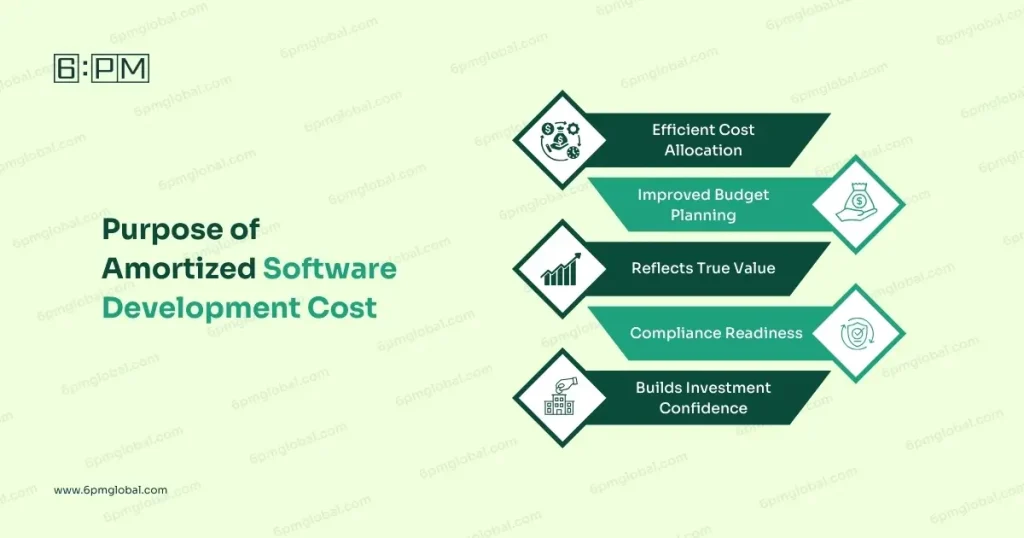
Efficient Cost Allocation
Amortization spreads expenses in line with the software’s actual use. The approach ensures that costs match the benefits the software provides over its lifecycle.
Improved Budget Planning
Your team gains better control over financial planning by predicting and managing costs over time. Ultimately, this will make it easier to allocate resources for future projects.
Reflects True Value
Amortization highlights the real contribution of your software as an asset. It showcases its role in supporting your company’s operations and growth which can help to increase brand value.
Compliance Readiness
Aligning with financial regulations ensures your business meets legal requirements. Also, it aligns documents for financial reporting, helping avoid issues during audits or regulatory reviews.
Builds Investment Confidence
Clear accounting practices boost trust with stakeholders and investors, showing them that your business is financially responsible. A balanced financial statement makes your business more appealing to potential investors.
Amortizing vs. Capitalizing in Software Development
Both are often used together, where costs are capitalized initially and then amortized over the software’s useful life. Here’s a table that clearly shows the difference between capitalizing and amortizing in software development :
| Aspect | Capitalizing | Amortizing |
|---|---|---|
| Definition | Recording software cost as an asset, it provides value over time | Spreading the price of the capitalized software over several years. |
| Purpose | Treating it as an investment, goes on the balance sheet as an asset. | Treating it as an investment goes on the balance sheet as an asset. |
| When Used | When the software is expected to benefit the company for many years. | After capitalization, it is amortized over its useful life. |
| Example | You build a software system and record the cost as an asset. | You then gradually expense the software cost over, say, 5 years. |
| Effect on Financials | Increases your assets on the balance sheet initially. | Reduces the capitalized asset and increases your expenses over time. |
Methods of Amortizing Software Development Costs and Examples
Let’s see some different methods of amortizing software development costs, and some examples to understand how they work in the context of your startup.
Methods of Amortizing
Units of Production Method
- How It Works: Amortize based on how much the software is used like, measuring transactions or users.
- Use It When: Software usage varies over time.
Sum-of-the-Years’-Digits (SYD) Method
- How It Works: More amortization in earlier years, less in later years.
- Use It When: Software loses value quickly.
Fixed Percentage Method
- How It Works: Apply a fixed percentage of the cost each year.
- Use It When: You want a consistent expense amount each year.
Accelerated Amortization
- How It Works: Write off more in the first years, then less in later years.
- Use It When: Software depreciates faster in the beginning.
MACRS (U.S. Tax Method)
- How It Works: Allows faster deductions for tax purposes, mostly used by the IRS (Internal Revenue Service) in the U.S.
- Use It When: You need quicker tax deductions.
Which Method to Choose for Startups?
- Straight-Line Method: The straight-line is the most common and recommended for software development costs. Specifically, if your software will provide steady value over time like productivity tools, custom internal systems, etc.
- Declining Balance Method: This method might be useful if your software has a shorter useful life. Also if you expect its value to depreciate more quickly, but this is rarer for software products.
Example in the Context of Your Startup
Suppose your startup builds computer software to help businesses manage their operations. Your costs incurred is $200,000 developing the app and expect it to be useful for 4 years.
- Using the Straight-Line Method: You would amortize $50,000 per year ($200,000 ÷ 4 years).
- Using the Declining Balance Method (say 40% rate): In the first year, you would amortize $80,000, and in the second year, you would amortize $48,000, and so on.
Why This Matters
Capitalizing and amortizing software costs allows your startup to spread the financial impact over time. It also reduces the upfront burden and matching costs with the income the software generates.
For tax purposes, amortization can help you manage profits and expenses more effectively, especially in the early stages when your startup might be focused on growth and reinvestment.
Factors Affecting Amortization Period
Here are some key factors that affect the amortization period for software development costs. Find the right amortization while considering these factors:

- Estimated Useful Life: You have to understand how long the software will be providing value to the business. A longer useful time means a longer amortization period.
- Technological Obsolescence: The rate at which technology evolves and makes the software outdated. Faster obsolescence leads to a shorter amortization period.
- Software Updates & Maintenance: Ongoing updates and maintenance to keep the software functional. Frequent updates could extend the useful life, potentially lengthening the amortization period.
- Market Demand: The demand for the software in the market. High demand and widespread adoption could extend the software’s useful life.
- Business Model: How the software is used in your business, such as subscription-based or one-time purchases. Software with ongoing revenue generation may have a longer amortization period.
- Legal & Regulatory Factors: Laws or regulations that impact the software’s functionality or updates. If rules require updates or extensions, it may affect the amortization timeline.
- Initial Cost & Investment: The amount spent on developing the software. Larger investments might lead to longer amortization periods to spread out the cost.
Conclusion
In conclusion, understanding amortized software development costs is really important for startups aiming for financial clarity and growth. By distributing costs systematically, businesses can maintain healthy cash flow, comply with regulations, and reflect true software value in financial statements.
Whether you’re managing software costs or planning future investments, choosing the right amortization method can make accounting easier. Use the tips and examples in this guide to simplify your startup’s finances and set up a strong foundation for success.
FAQs
How do I know if software costs need to be capitalized?
You should capitalize on software development costs when the software is in the research and development phase for internal use or resale and has a useful life beyond one year.
Also, it is expected to provide future economic benefits when it is technologically feasible.
Can startups benefit from shorter amortization periods?
Yes, startups can definitely benefit from shorter amortization periods in the right circumstances. It is mainly for tax benefits, cash flow management, and software that has a short useful life.
What is the typical amortization period for software development costs?
The most typical amortization period for software development costs is 3 to 5 years. However, it could be shorter or longer, depending on how long the software is expected to provide value to the business.
What happens if the software is abandoned mid-development?
Write off the capitalized costs as expenses if the software is abandoned during mid-development. Also, stop amortizing the software costs, as it no longer provides future benefits.
Can I change the amortization method later?
Yes, you can change the amortization method for software, but you need a valid reason. Unless it’s material enough to require a retrospective adjustment, the change must be applied onwards.