


Did you know that 64% of companies now use software team augmentation to meet their development needs? This strategy has become a game-changer, helping businesses quickly fill skill gaps and scale their teams without the long-term commitment of traditional hiring.
Well, you need software team augmentation to stay competitive, especially when specialized skills are required but hard to find. It’s the smartest way to adapt to changing project demands without overextending your resources.
Curious about how this approach can benefit your business? Keep reading to discover the importance, challenges, and best practices for effectively using team augmentation in your organization.
Let’s start!
What is Software Team Augmentation?
Software team augmentation is an outsourcing strategy where a company adds external experts to its in-house team. These professionals join the internal staff temporarily or for extended periods, depending on project needs.

Moreover, this approach helps businesses quickly access specialized skills and increase their team’s capacity without hiring permanent employees. Unlike full project outsourcing, where an entire project is managed externally, team augmentation involves external developers working directly with the in-house team.
According to Grand View Research, the global IT outsourcing market, which includes team augmentation services, was valued at USD 744,623.5 million in 2024 and is expected to grow at a compound annual growth rate of 8.6% from 2025 to 2030. This highlights the increasing demand for flexible staffing solutions.
Overall, the method ensures collaboration and alignment on specific tasks or projects. This also makes it a flexible and efficient solution for meeting project demands.
Team Augmentation vs. Outsourcing vs. Managed IT Services
| Criteria | Team Augmentation | Outsourcing | Managed IT Services |
|---|---|---|---|
| Purpose | Increase specific skills or team capacity | Hand over entire projects or parts of projects | Full management of IT infrastructure |
| Supervision | Direct supervision by the company’s management | Managed partly by the external provider | Managed entirely by the third-party provider |
| Project Involvement | Integrated with the in-house team | Independent project handling | Continuous, ongoing IT management |
| Control | High control, aligned with the company’s goals | Moderate control, based on project specifications | Low control, focus on service level agreements (SLAs) |
| Ideal For | Projects requiring specific skills or team scaling | Projects that can be independently managed | Offloading entire IT operations |
Why Do You Need Software Staff Augmentation?
Software team augmentation is an amazing strategy for companies looking to enhance their development capabilities without the long-term commitment of hiring full-time employees.
Here are some reasons why this method is beneficial:
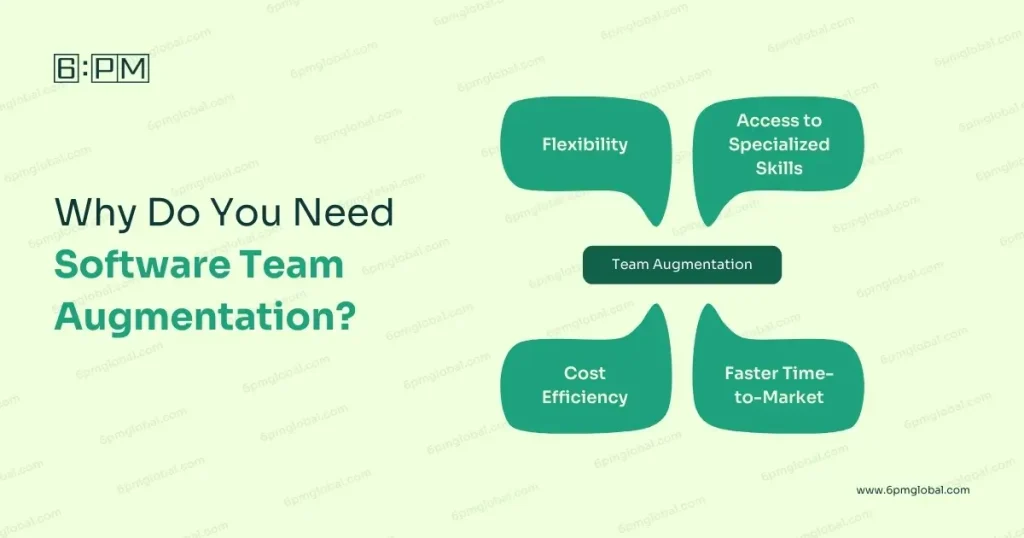
Flexibility
Software team augmentation lets businesses adjust their team size based on project demands. You can easily scale up or down without the commitment of permanent hires.
Well, flexibility is needed in today’s market, where project needs can change rapidly.
Access to Specialized Skills
Companies can quickly bring in external experts with specific skills that are not available in-house.
Whether you need niche technical expertise or a fresh perspective, team augmentation makes sure that your projects are handled by professionals with the required skills.
Cost Efficiency
Augmenting your team helps avoid the high costs of recruitment, training, and maintaining long-term employees. This method also allows you to tap into a global talent pool, often at a lower cost than local hires, which makes it a budget-friendly solution.
Faster Time-to-Market
With experienced professionals joining your team, you can accelerate project timelines. It means your company can bring products and services to market more quickly, giving you dominance in delivering solutions to your customers.
The Importance of Software Team Augmentation Service
Software team augmentation plays a great role in helping businesses stay competitive and agile in today’s fast-changing market. Let’s find out some reasons why it is so important:
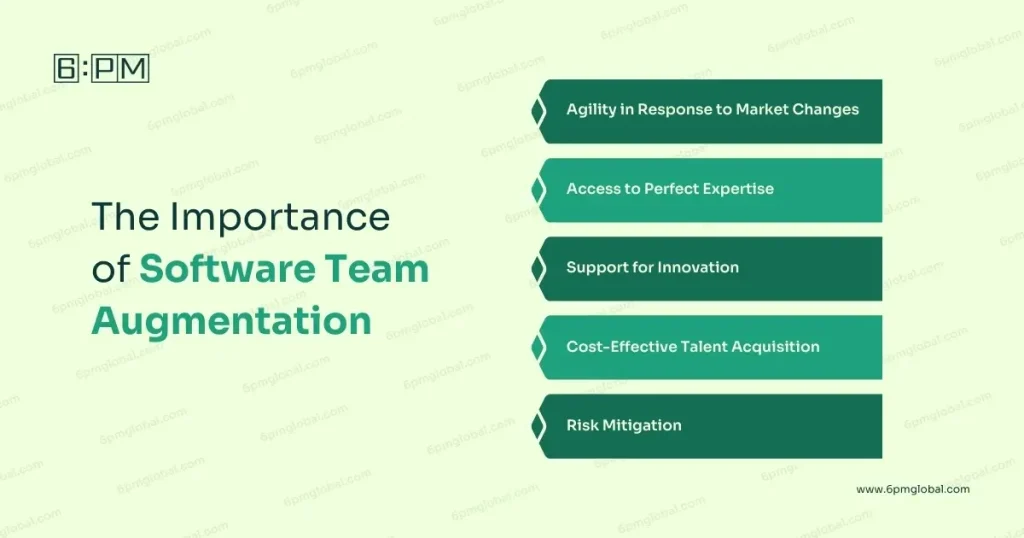
Agility in Response to Market Changes
Software team augmentation allows businesses to adjust their teams to meet changing market demands quickly. When new challenges or opportunities arise, you can bring in the necessary talent swiftly, ensuring your company remains responsive and competitive.
Access to Perfect Expertise
The fast pace of technological advancements means that having access to the latest skills is essential. Team augmentation helps you to bring in experts with up-to-date knowledge of emerging technologies. Plus, this ensures your projects are at the forefront of innovation.
Support for Innovation
Experimenting with new ideas and technologies is crucial for staying ahead in the market. Team augmentation lets you test new concepts without the long-term commitment or risks of hiring permanent staff, making it easier to innovate and explore new opportunities.
Cost-Effective Talent Acquisition
Finding and hiring specialized talent can be expensive and time-consuming. Team augmentation provides a cost-effective alternative. It allows you to bring in skilled professionals as needed without the overhead of recruitment, training, and full-time employment.
Risk Mitigation
Last but not least, the ability to scale your team up or down as needed reduces the risks associated with fluctuating project demands. Team augmentation ensures you can manage workload spikes or slow periods without the financial strain of maintaining a large permanent staff.
When Do You Need Software Team Augmentation?
Software team augmentation can be amazing for your business in various situations. Here are the main scenarios where this approach is beneficial:
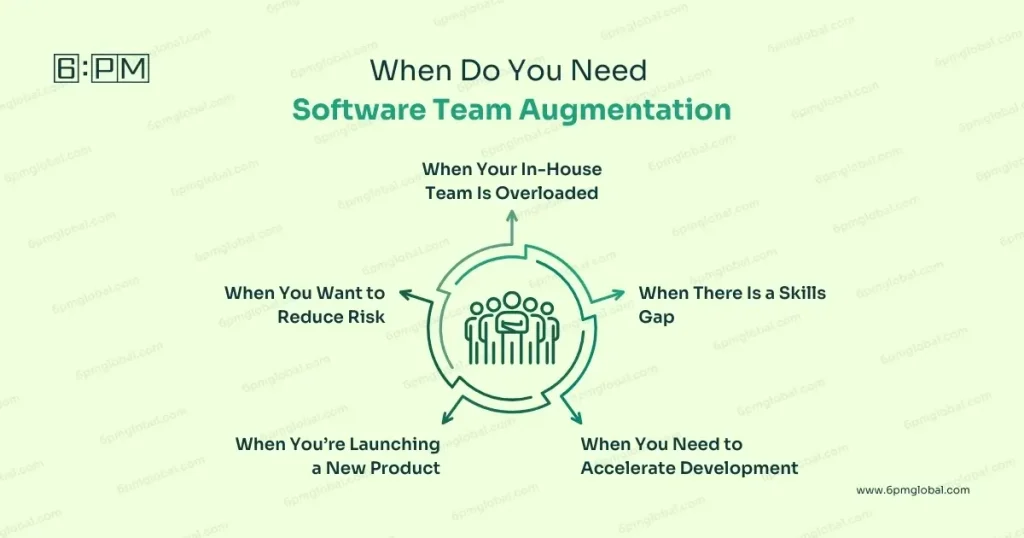
Your In-House Team Is Overloaded
If your team is struggling to keep up with deadlines or is overwhelmed by a heavy workload, augmenting the team can provide much-needed support. Bringing in additional talent helps distribute the workload more evenly, ensuring projects stay on track and reducing stress for your core team.
There Is a Skills Gap
Sometimes, a project requires expertise that your current team doesn’t possess. Instead of going through a lengthy hiring process, team augmentation allows you to quickly bring in specialists with the specific skills needed.
This ensures that your project is executed with the highest level of expertise.
You Need to Accelerate Development
Tight deadlines or urgent projects can be challenging for your existing team to handle alone. Augmenting your team with extra resources can help speed up the development team process.
It allows you to meet deadlines and deliver your project on time without compromising on quality.
You’re Launching a New Product
A product launch is a critical time that requires diverse skills and experience. Augmenting your team ensures that you have all the necessary expertise to deliver a successful product.
This method allows you to bring in professionals who can contribute to different aspects of the launch, from software development to marketing.
You Want to Reduce Risk
Large projects often come with high risks, especially when it comes to meeting deadlines or maintaining quality. By augmenting your team, you can reduce these risks by ensuring you have the right talent available to handle unexpected challenges.
This approach also allows for more flexibility in managing project demands.
Challenges of Software Staff Augmentation Services
While software team augmentation provides many benefits, it also comes with its own set of challenges that businesses need to navigate carefully. Here are five key challenges to be aware of:
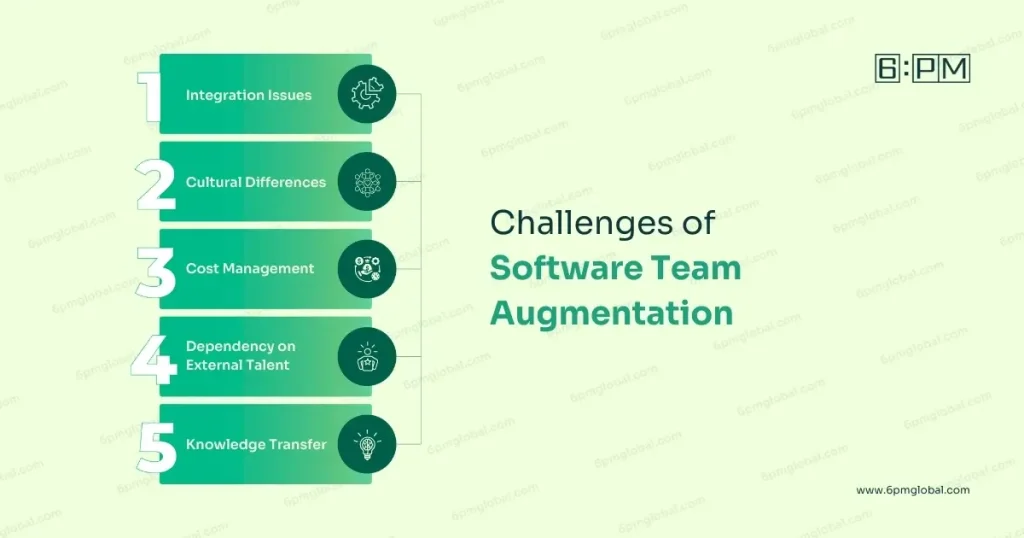
Integration Issues
Bringing external developers into an existing team can be tricky, especially in terms of communication and collaboration.
So, ensuring that external talent meshes well with your in-house team requires careful planning. Also, clear communication channels are required to avoid misunderstandings and ensure smooth project progress.
Cultural Differences
Working with a global talent pool often introduces cultural and language barriers. These differences can affect communication, work styles, and expectations. To bridge these gaps and maintain a cohesive team dynamic, it’s essential to foster a culture of understanding and adaptability.
Cost Management
While team augmentation can save money, it can also become costly if not managed carefully, particularly when hiring experts in high-demand skills. It’s important to monitor costs closely and ensure that the value gained from external talent justifies the investment.
Dependency on External Talent
Relying too much on external resources can create a dependency that might hinder your company’s ability to develop in-house capabilities. To mitigate this, it’s important to balance the use of external talent with efforts to grow and train your internal team.
Knowledge Transfer
When external developers leave, they take their knowledge and experience with them. This can create gaps in your team’s understanding of the project.
To avoid this, ensure proper documentation and knowledge transfer processes are in place to retain critical project insights within the company.
Best Practices for Team Augmentation
To get the most out of software team augmentation, it’s important to follow some key best practices. Here are the essential steps to ensure success:
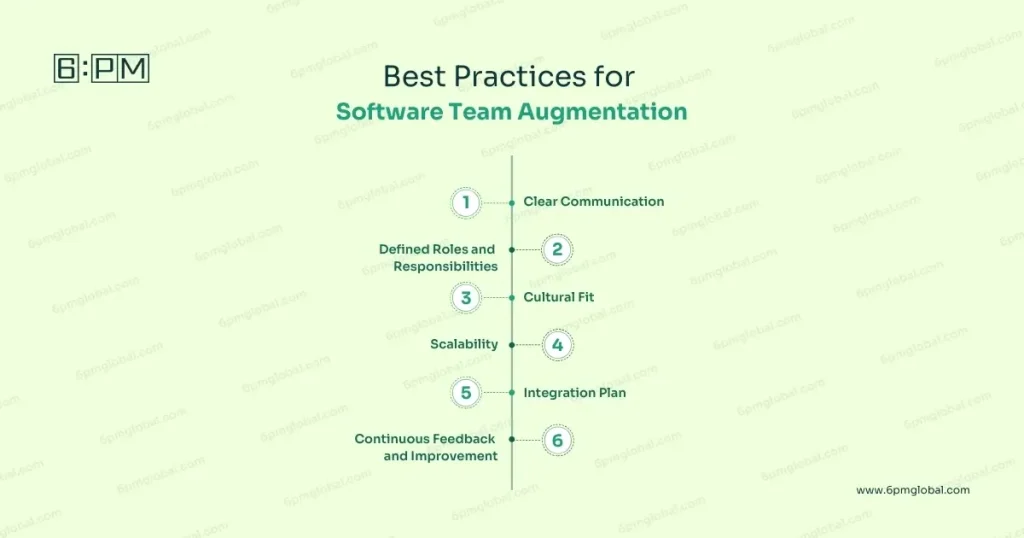
Clear Communication
Maintain clear and ongoing communication between your in-house team and the augmented staff. Regular meetings, updates, and the use of collaboration tools are vital for keeping everyone on the same page.
This helps to prevent misunderstandings and ensures that the project moves forward smoothly.
Defined Roles and Responsibilities
Clearly outline the roles and responsibilities for both in-house and augmented team members. It prevents overlaps and ensures everyone knows their tasks and who is accountable for what.
So, by setting these boundaries early on, you create a more efficient and focused team environment.
Cultural Fit
When selecting external team members, consider their cultural compatibility with your existing team. A good cultural fit promotes better collaboration and reduces the potential for conflicts.
It’s important to choose team members who can easily adapt to your company’s work style and values.
Scalability
Work with a team augmentation partner that can scale your team as the project evolves. Whether you need to add more developers or reduce the team size, having the flexibility to adjust resources ensures you’re always prepared to meet the project’s demands at every stage.
Integration Plan
Develop a detailed integration plan that includes onboarding, training, and alignment with your company’s processes and culture.
A well-thought-out plan helps external team members get up to speed quickly and ensures they work effectively alongside your in-house team from day one.
Continuous Feedback and Improvement
Regularly gather feedback from both in-house and augmented team members to identify areas for improvement.
It helps refine processes, enhance collaboration, and ensure that any issues are addressed promptly. Continuous improvement keeps the team aligned and contributes to the project’s overall success.
Final Verdict
To sum up, we can say that software team augmentation is valuable for improving your software development capabilities while keeping flexibility and control. By bringing in external talent, you can quickly fill skill gaps, speed up project timelines, and stay competitive in a fast-paced market.
However, to fully reap the benefits, approach team augmentation with careful planning, clear communication, and a focus on integrating the new members smoothly with your in-house team.
Therefore, properly managing these elements will help you overcome challenges and make the most of this effective model for scaling your development efforts.
Good luck!
FAQs
Is team augmentation suitable for long-term projects?
Yes, team augmentation can be used for both short-term and long-term projects. For long-term projects, it provides the flexibility to adjust team size and skills as the project evolves without the commitment of hiring permanent employees.
How do I integrate external team members effectively?
To integrate external team members, provide a clear onboarding process, define roles, and ensure they understand your company’s processes. Use collaboration tools, schedule regular meetings, and promote open communication to help them align with your in-house team and work effectively.
Can I control the work of augmented team members?
Yes, with software team augmentation, external team members work under your management, allowing you to maintain full control over the project. They integrate with your in-house team, follow your guidelines, and collaborate closely with internal staff to meet project goals.