


Did you know that over 40% of startups fail due to poor technology leadership? Well, the solution is an interim CTO. He can change that by offering quick, high-level tech expertise without a long-term commitment.
How do you hire one, then?
To hire an interim CTO for your startup, identify your immediate technical needs, set clear objectives, and find someone with experience relevant to your industry and business size. You can also use trusted networks or specialized agencies for a quick search.
Keep reading to find out the full role of this CTO, the benefits they bring, how to find the right one for your business, and what to expect in terms of cost.
Let’s begin!
What is an Interim CTO?
An Interim Chief Technology Officer (CTO) is a temporary executive brought in to manage a company’s technology needs for a set period. They focus on short-term goals, such as improving technology department strategies, managing product development, or resolving urgent technical issues.

Unlike a full-time CTO, this short-term or temporary CTO provides expertise during critical phases, like a digital transformation or product launch. Their role is to guide the company through these challenges until a permanent CTO is hired or the immediate issues are addressed.
Overall, they offer flexible, high-level support without the long-term commitment of a full-time role.
Difference Between Interim CTO and Business-Focused CTO
Here’s a comparison table that highlights the differences between an Interim CTO and a Business-Focused CTO:
| Aspect | Business-Focused CTO | Interim CTO |
|---|---|---|
| Duration | Long-term, permanent position | Short-term, temporary role |
| Focus | Aligning technology strategy with long-term business goals | Addressing immediate technical needs or challenges |
| Role in the Company | Deeply inserted in company structure and culture | Brought in for specific tasks or urgent situations |
| Responsibilities | Management, strategy, and industry networking | Solving specific technical issues, guiding short-term projects |
| Commitment | Long-term, ensuring sustainable growth | Limited commitment, focused on short-term objectives |
| Recruitment | Part of long-term staffing and leadership | Hired for quick impact and results |
Who Needs an Interim CTO?
An interim or fractional CTO is necessary for you if you need temporary, high-level technology leadership. Let’s find out some types of businesses that can benefit from hiring them:
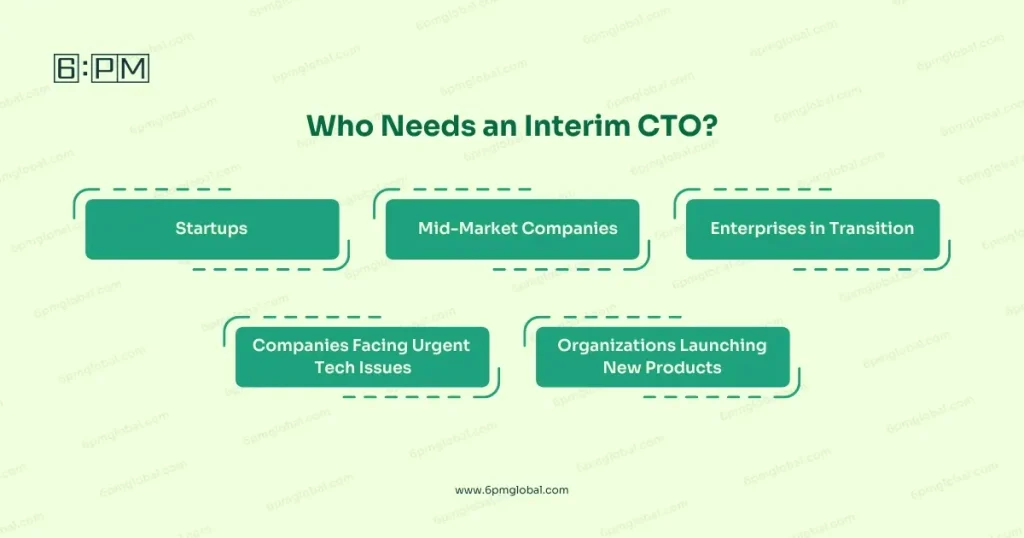
Startups
Early-stage companies often need expert guidance on technology without committing to a full-time executive. A short-term CTO helps define the tech strategy, manage product development, and improve investor confidence by providing high-level expertise without long-term costs.
Mid-Market Companies
Growing businesses undergoing rapid changes or facing technological shifts can benefit from a temporary CTO. They offer leadership in scaling operations, hiring technical staff, or navigating transformation. This helps the company remain competitive during tough growth phases.
Enterprises in Transition
Large organizations going through mergers, acquisitions, or major projects may need a placeholder CTO to ensure smooth technology operations. It allows the business to stay on track while the search for a permanent CTO continues.
Companies Facing Urgent Tech Issues
Businesses dealing with urgent technical problems, such as infrastructure breakdowns or cybersecurity threats, may need a short-term CTO. Their quick, focused approach helps address critical issues and ensures business continuity.
Organizations Launching New Products
Companies about to launch new products or enter new markets may require the expertise of an interim CTO. They can provide the technical leadership needed to guide development, manage teams, and make sure about the successful execution of the project.
Why Do You Need to Hire an Interim CTO?
Hiring a interim CTO has a range of benefits, especially for businesses that need temporary, high-level technology leadership. Here’s why you should consider hiring an interim CTO:
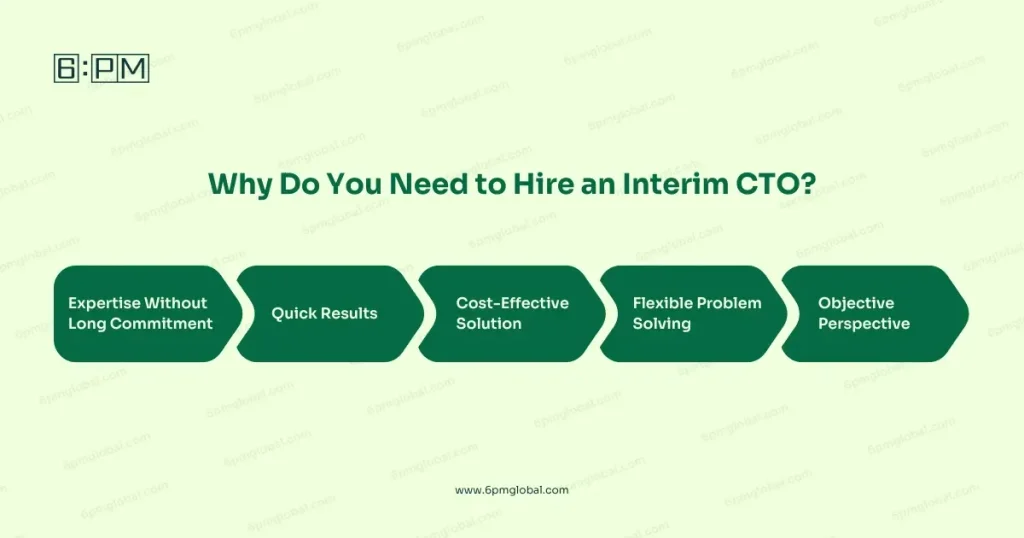
Expertise Without Long Commitment
A transitional CTO provides access to top-tier expertise without the long-term commitment or financial burden of a full-time executive. This allows companies to get expert guidance when needed without being tied down to a permanent role.
Quick Results
Transitional CTOs come with extensive experience, enabling them to start delivering results quickly. They can hit the ground running, ensuring tough projects are executed swiftly and efficiently without the usual onboarding delays.
Cost-Effective Solution
For startups or small businesses, hiring a temporary CTO can be more affordable than bringing on a full-time executive. The solution helps businesses to get the leadership they need without overspending on salary and benefits.
Flexible Problem Solving
Well, a short-term CTO can be brought in for specific tasks, such as solving urgent technical issues or guiding a project launch. Their role is flexible and focused on addressing immediate needs, and they leave once the job is done. This makes it a highly adaptable option.
Objective Perspective
Since provisional CTOs are not tied to the company long-term, they bring an objective, unbiased perspective to the organization’s technology strategy. This allows them to make clear, focused decisions without being influenced by internal politics or long-term concerns.
Roles and Responsibilities of an Interim CTO
An interim CTO takes on a variety of important technical leadership tasks to ensure smooth operations and strategic growth. Let’s talk about the roles and responsibilities they handle:
- Establishing Software Development Processes: The temporary CTO sets up efficient development processes that ensure the team follows a clear workflow to deliver quality software on time. This includes choosing the right tools and methodologies for the project.
- Defining Software Architecture and Database Design: They design the software architecture and database structure, ensuring it supports scalability, security, and performance. The foundation is needed for building a stable and efficient technology infrastructure.
- Creating the Product Roadmap: The shortgap CTO creates a detailed roadmap to define the product’s future direction. This helps align the development team’s efforts with the company’s long-term business goals and customer needs.
- Managing Recruitment and Team Management: They are responsible for recruiting, mentoring, and managing the development team. The process confirms that the company has the right talent and skills to achieve its technical objectives.
- Implementing Best Practices in Development and Project Management: The provisional CTO introduces best practices for coding, testing, and project management. It makes sure the development process runs smoothly and delivers high-quality results on time.
- Advising on Cloud Infrastructure and New Technologies: They provide strategic guidance on selecting and implementing cloud infrastructure and emerging technologies. This ensures the business stays competitive and can scale efficiently.
- Connection Between Technical Teams and Investors: Acting as a bridge, the interim CTO communicates the technical vision and progress to investors. It ensures they understand the company’s technology strategy and its alignment with business goals.
- Managing Technology Budgets: The transitional CTO manages the technology-related budget. It assures efficient resource allocation for infrastructure, software tools, and team costs to support current needs and future growth.
Benefits of Hiring an Interim CTO
Hiring an interim CTO offers lots of advantages that can benefit businesses during critical stages of growth or transition. Here’s why bringing in a temporary CTO may be a smart move:
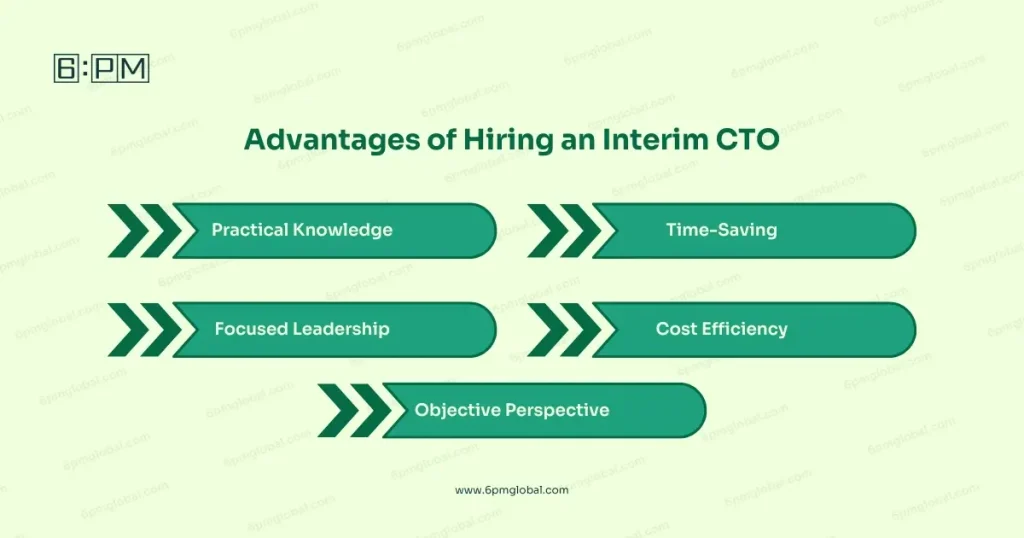
Practical Knowledge
Provisional CTOs bring a wealth of hands-on technical expertise and experience, which helps businesses avoid costly mistakes. Their deep understanding of technology ensures that they can quickly identify and solve technical challenges, providing immediate value.
Time-Saving
With their huge experience, incidental CTOs can simplify processes and make quick, informed decisions. This leads to faster product launches and smoother operations. Plus, it makes sure that the company stays ahead of the competition and meets critical deadlines without delays.
Focused Leadership
Well, an provisional CTO takes full responsibility for the company’s technical operations. It allows founders and executives to focus on other core business activities. Also, this focused leadership ensures that technology strategies align with business goals while allowing the rest of the team to remain productive.
Cost Efficiency
Hiring a short-term CTO for specific projects or during transitional periods is often more cost-effective than hiring a full-time executive. You can get high-level expertise without the long-term financial commitment that makes it a budget-friendly solution for short-term needs.
Objective Perspective
Since they are not tied to the company long-term, transitional CTOs bring a fresh, unbiased perspective.
They can offer objective insights into the company’s technology strategy. It helps identify areas of improvement and provides solutions that align with business goals without being influenced by internal politics.
Qualifications of an Interim CTO for a Startup
The ideal interim CTO for a startup should have:
- Experience in founding or managing a company as a CTO.
- Expertise in the startup’s specific industry (e.g., SaaS, B2B, consumer apps).
- Deep knowledge of relevant technologies.
- Strong leadership and mentorship skills to guide the technical team.
- Experience with cloud infrastructure, database design, and software architecture.
- The ability to wear multiple hats and adapt to the startup environment.
How to Hire an Interim CTO: 6 Excellent Steps
Hiring a temporary CTO can be a strategic move for startups and companies facing urgent technological challenges. It’s important to approach this process with a clear plan to find the right person to deliver results quickly.
Here’s a step-by-step guide to help you successfully hire an interim CTO:
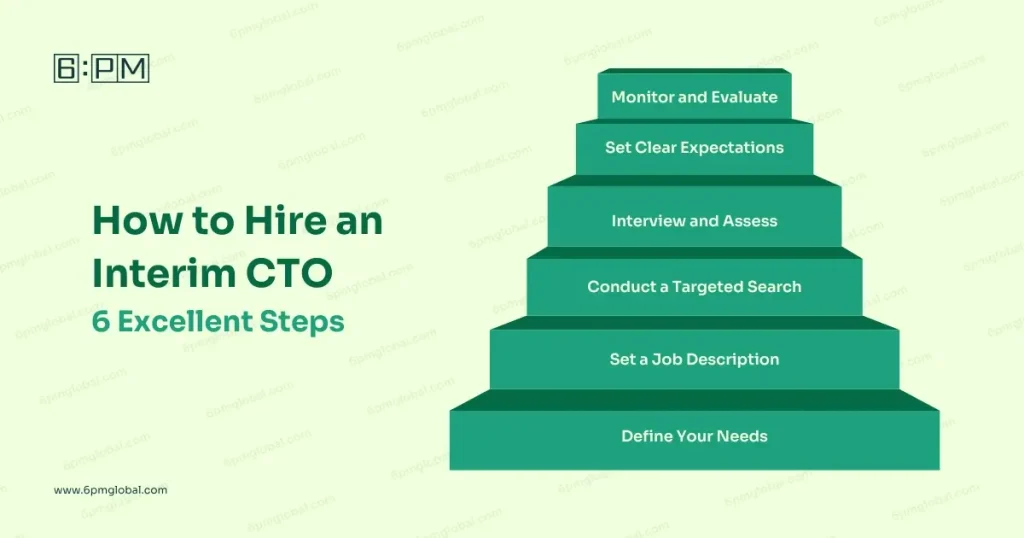
Define Your Needs
Start by identifying the specific responsibilities and goals of the provisional CTO within your company. Consider what challenges need to be addressed, such as launching a product, resolving technical issues, or improving infrastructure.
Moreover, be clear about the role’s scope to ensure you find someone with the right expertise to meet your startup’s immediate needs.
Set a Job Description
Next, write a detailed job description that includes the necessary technical skills, industry experience, and key deliverables. Highlight the qualities and abilities your company requires, such as leadership, project management, or experience in specific technologies.
Remember that a well-crafted job description helps attract candidates who are both technically capable and aligned with your company’s goals.
Conduct a Targeted Search
Then, use specialized recruitment firms, professional networks, or industry platforms to search for candidates with the right expertise. Look for individuals who have experience in similar roles and industries.
You can also use recommendations from trusted contacts or advisors to find interim CTOs with a proven track record.
Interview and Assess
During interviews, evaluate both technical skills and the candidate’s ability to fit into your company’s culture. Ask about their past experiences leading technical teams, managing projects, and solving specific problems.
So, make sure they are adaptable and able to work in a startup environment while aligning with your company’s vision and values.
Set Clear Expectations
Once you’ve chosen a candidate, agree on specific goals, timelines, and the scope of work. Clearly outline their responsibilities, expected deliverables, and the metrics by which their performance will be measured.
Thus, setting clear expectations from the start helps both parties stay focused and ensures the short-term CTO’s efforts are aligned with the company’s objectives.
Monitor and Evaluate
Last but not least, the interim CTO’s performance should be regularly assessed against the agreed-upon goals and metrics. Conduct periodic check-ins to discuss progress, challenges, and any adjustments needed.
Monitoring their performance helps ensure they meet your company’s needs and allows for timely interventions if necessary.
Challenges of hiring an Interim CTO
Though interim CTO can bring many benefits for your start-up, you may face some other set of challenges. Let’s see some challenges with interim CTO:
Time Pressure
Challenge: Interim CTOs are expected to deliver results quickly since their role is temporary.
Solution: They focus on quick wins, set clear priorities, and address the most critical issues first.
Understanding Existing Systems
Challenge: The CTO may encounter unfamiliar tools, systems, or workflows.
Solution: They quickly assess the current setup and use the team’s expertise for a smoother transition.
Pressure to Show Immediate Results
Challenge: Founders and investors expect quick improvements, which can be overwhelming.
Solution: The interim CTO may set realistic expectations and communicate progress regularly.
Tight Budgets
Challenge: Limited resources can restrict decision-making.
Solution: The CTO can find cost-effective solutions that meet immediate needs without sacrificing long-term growth.
Transitioning Out
Challenge: Ensuring continuity after their exit can be tricky.
Solution: They can document their work thoroughly and guide the next person stepping into the role.
Cost of Hiring an Interim CTO
The cost of hiring an interim CTO depends on factors like region, industry, and the length of the engagement. Most short-term CTOs charge a daily rate, typically ranging from $1,000 to $3,000, based on their experience and expertise.
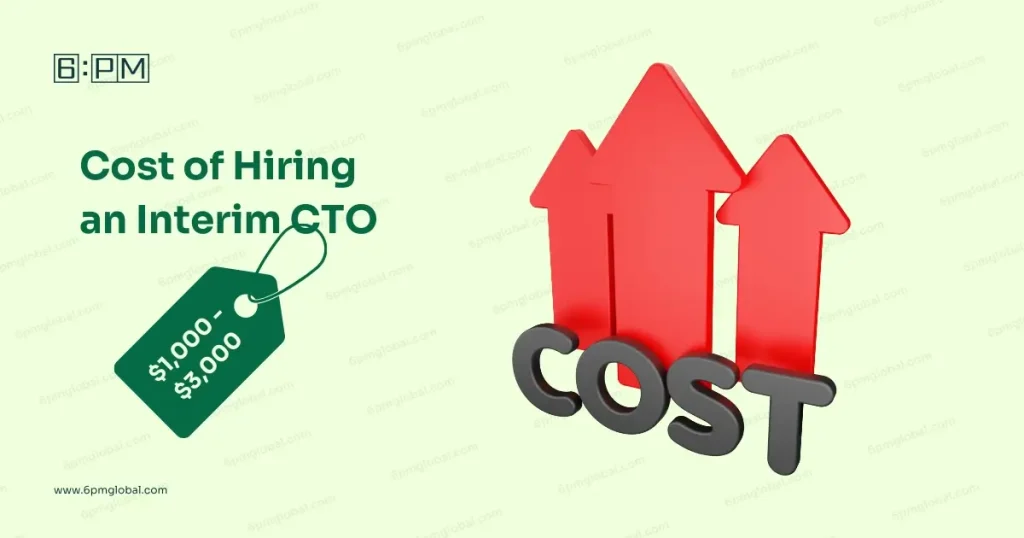
For more extended engagements or complex projects, the total cost can reach six figures. Some interim CTOs may offer project-based pricing, which varies depending on the scope of work.
While this may seem costly, it can be a more affordable option compared to hiring a full-time executive, especially for short-term needs or specific technical challenges.
The Bottom Line
To wrap up, an interim CTO is a smart solution for you if you’re dealing with immediate technology challenges. Whether you’re a startup launching a new product or a large company undergoing a digital transformation, a temporary CTO provides flexible, expert leadership without an extended commitment.
To get the most value, make sure you define your needs clearly and hire someone with the right experience for your industry. Look for a candidate who can quickly understand your business, deliver results, and align with your company’s goals.
With the right provisional CTO, you can increase your growth, improve operations, and stay competitive in the tech world.
All the best!
FAQs
How does an interim CTO differ from a full-time CTO?
A full-time CTO is a permanent leader focused on long-term goals, while an interim CTO is brought in for short-term projects or urgent needs. The interim CTO offers temporary leadership without extended commitment.
What industries can benefit from an interim CTO?
Interim CTOs benefit startups, midsize companies, and large enterprises in industries like SaaS, B2B, and tech-heavy sectors. They help businesses needing quick technical leadership, such as during rapid growth or product development phases.
How long does an interim CTO typically stay with a company?
The duration varies based on the project or company’s needs, ranging from a few months to a year. An interim CTO stays until specific goals are met, such as completing a product launch or resolving technical challenges.